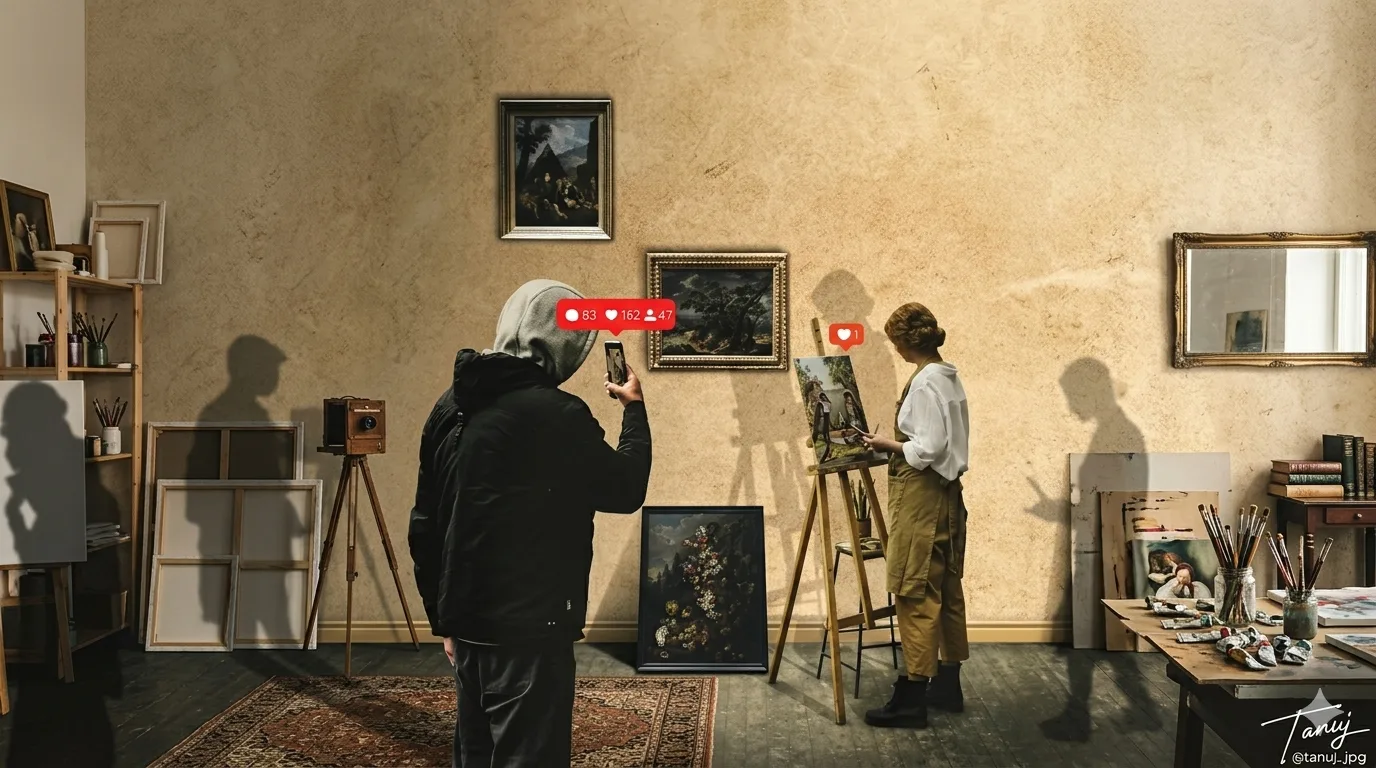
There was a time when art existed in silence; written in notebooks, painted in isolation, composed without any audience in mind. Today, that silence is perceived as absence. In a digital environment where prominence indicates reach, the act of creating and the act of being seen have collapsed into one single gesture. The concern is no longer just to create, but to be seen; shifting the focus from presence to relevance.
WHEN VISIBILITY WAS NOT THE POINT
To understand how visibility has become a prerequisite to define creative practice today, it is important to look at the time when it didn't carry the same weight. In earlier artistic contexts, visibility was very much present, but it was detached from the art of creation. Artists such as Franz Kafka and Amrita Sher-Gil created art in environments where visibility did not dictate their artistic practice. Czech-origin writer Franz Kafka is a prime example; he had published only a handful of short writings. For him, writing was a form of prayer, an internal struggle that didn't necessitate the validation of a legacy, let alone an audience.
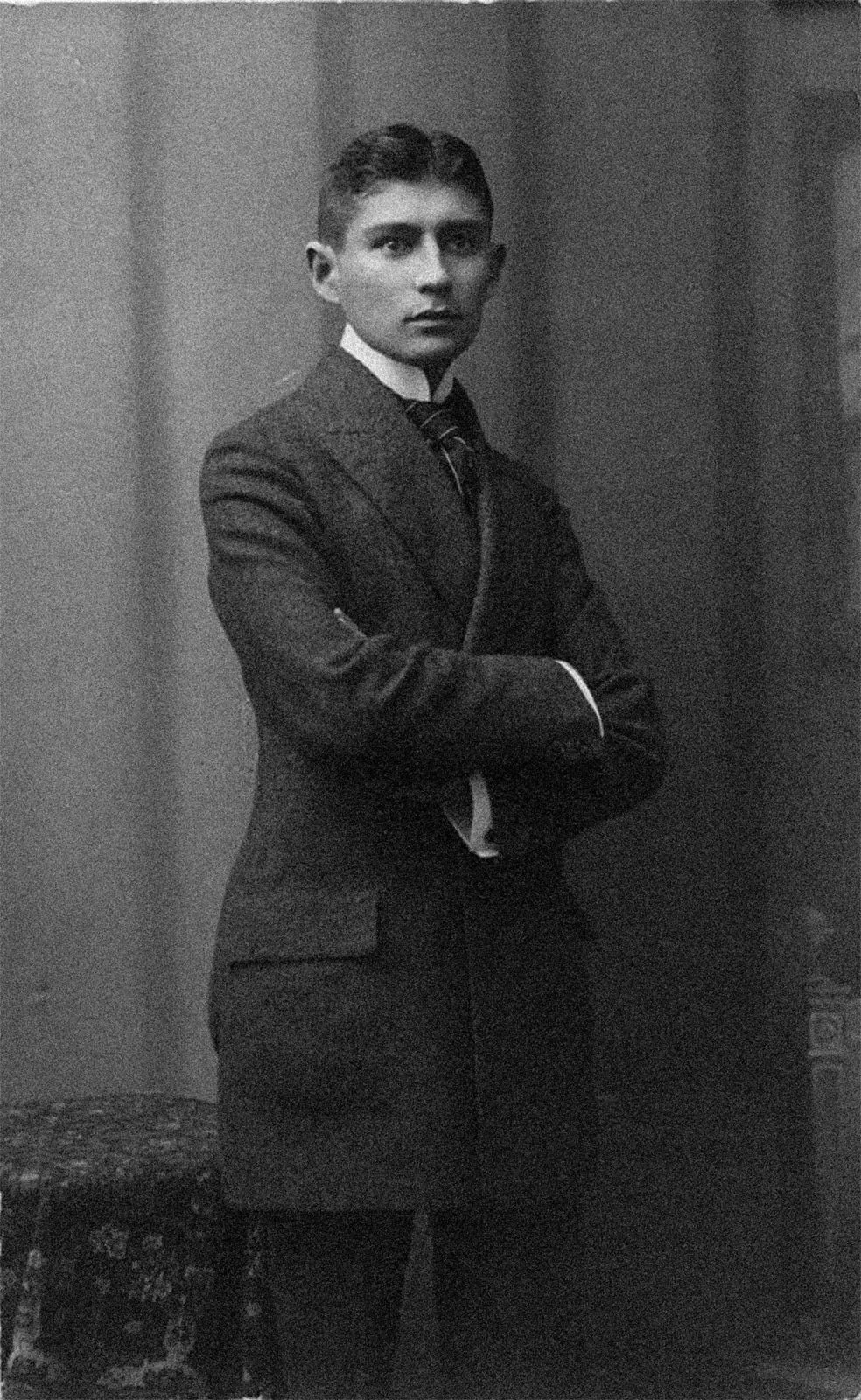
FRANZ KAFKA
Amrita Sher-Gil, a Hungarian-Indian eminent painter in Indian art history, has created artwork depicting intimate details and the daily lives of women, rooted in global modernity. Her art was deeply introspective, derived from her personal experiences and observations as a woman. Sunaina Anand, the founder and Director of Art Alive Gallery, stated, “It is not just about marketing a commodity well; the true value of art lies in its aesthetics and its power to make an impact.” In this regard, Sher-Gil knew how to make that impact through a body of work built in obscurity, yet enduring in its resonance.
Amrita Sher-Gil Photographed By Umrao Singh Shergill In Paris
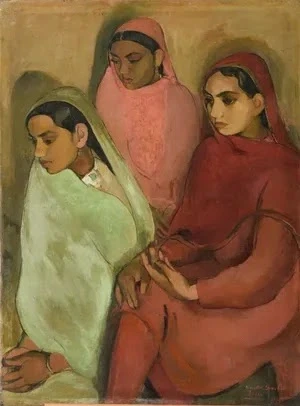
Three Little Girls Painting By Amrita Sher-Gil, Image Via Encyclopedia Britannica
VISIBILITY AS CURRENCY
There is a sharp dichotomy when placed against the present, with figures such as the 46-year-old American bestselling author Colleen Hoover. She gained her share of fame through a community created by the Gen-Z audience on TikTok called Booktok. Novels that she had written years ago suddenly entered the bestseller charts, because of the change in visibility rather than the art itself, in this case, her writing, which eventually led her 2016 book It Ends With Us being adapted into a major motion picture: released in over 3611 theatres worldwide, along with grossing over $351 million. At the end of the day, the real question that remains is, if it weren't for BookTok, would she still be as renowned as she is currently?
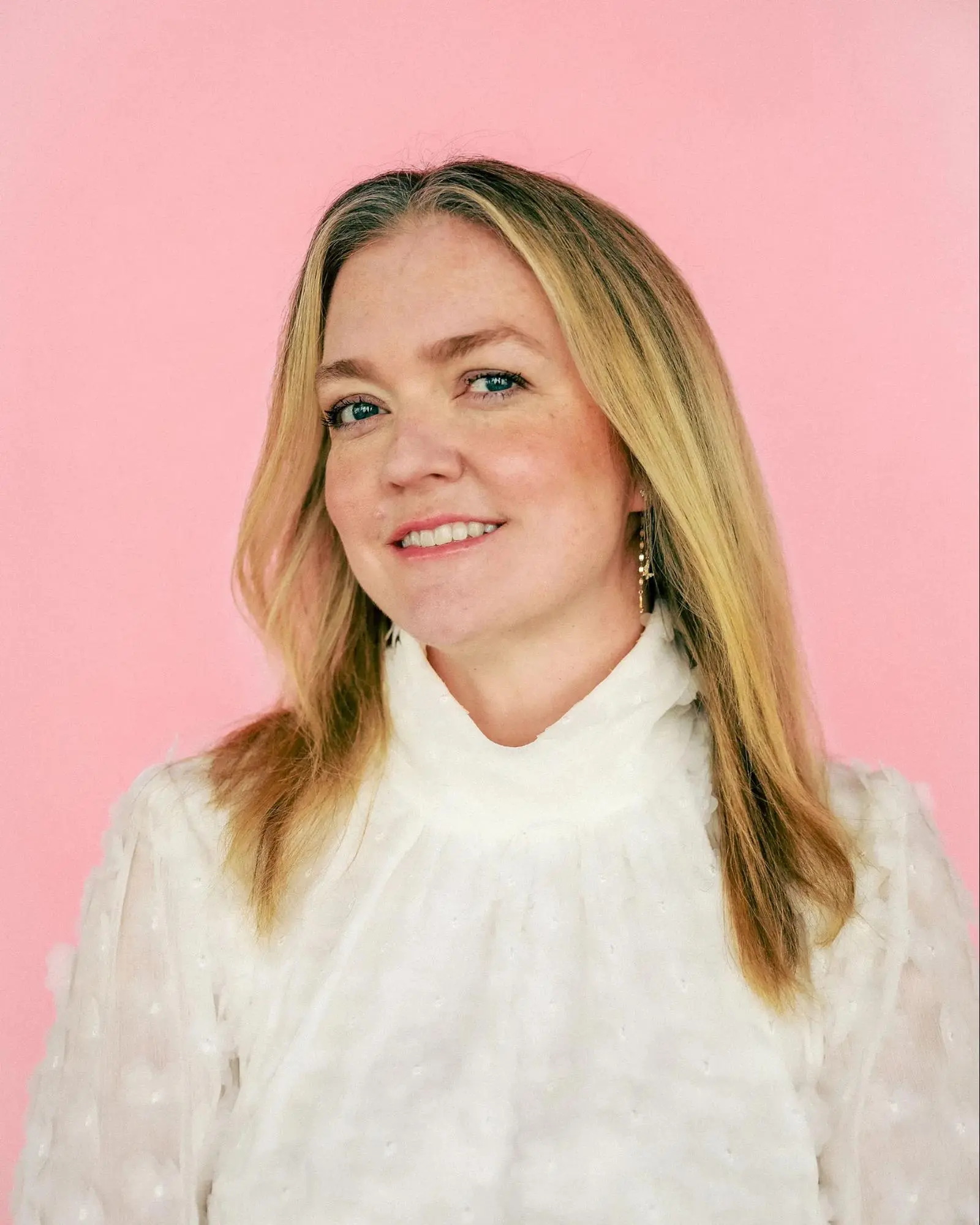
Colleen Hoover Image Shot By Jasmine Archie; Texas Monthly

Tiktok Screenshot By Maddie Bueyan
Where names like Colleen Hoover represent the artists whose creations catapulted into visibility, Virgil Abloh, Founder of Off-White and Artistic Director of Louis Vuitton, represented something even more complex. Abloh built his creative identity around the concept of design modification, specifically the 3% rule, which centered on his philosophy of altering or refining a product by a mere 3% from its original state. Abloh quoted this at a Harvard lecture in 2017: “Design is like DJing. You take existing sounds, and you recontextualise them”. Abloh blurred the line between being a public icon and an artist. As designer and founder of the homegrown brand HUEMN, Pranav Kirti Misra notes, “Art is bigger than the artist, and the artist is bigger than the stage”. In this case, Abloh’s legacy still lives on, and he knew how to utilise his visibility without letting it overpower his creative prowess.
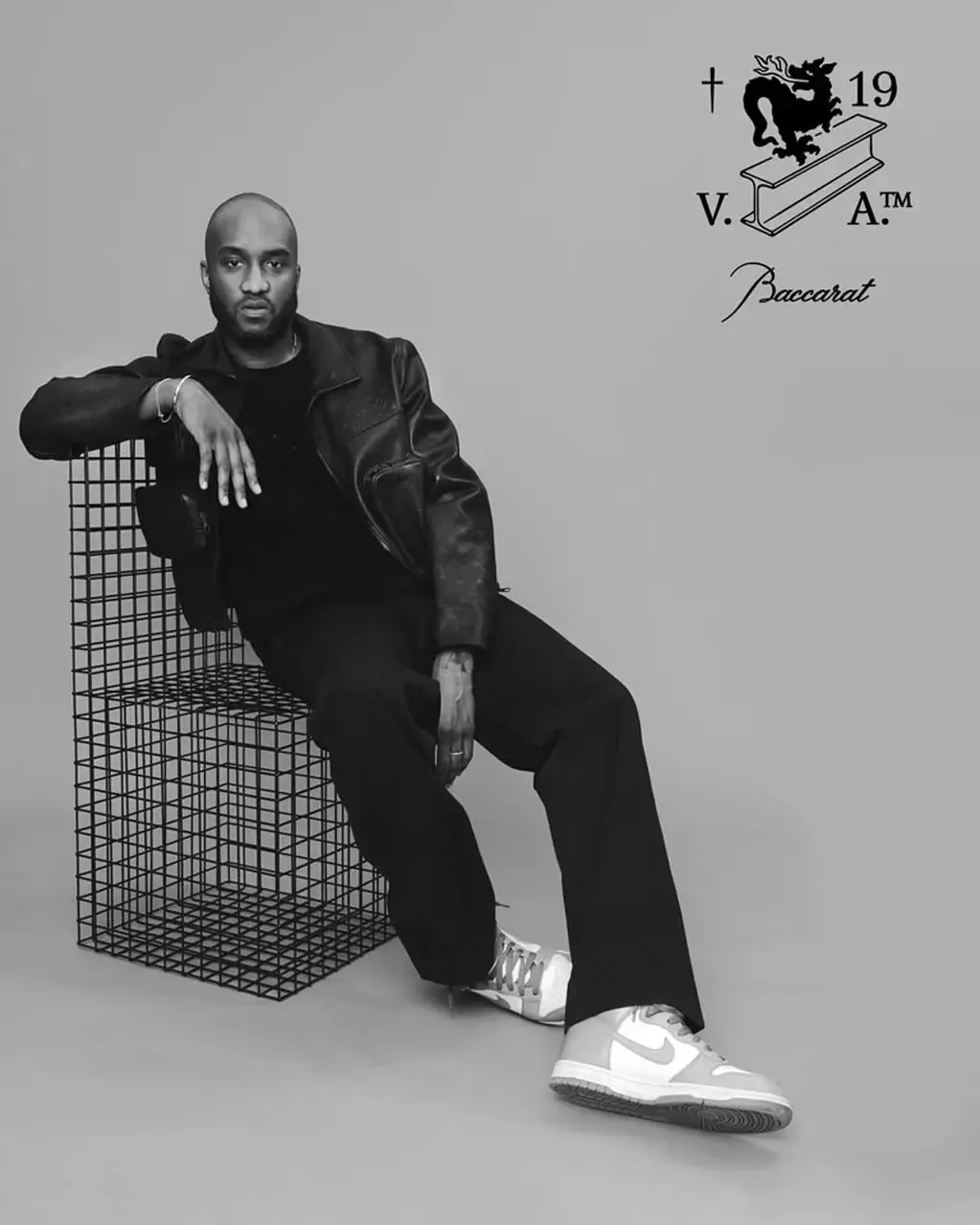
Virgil Abloh For Baccarat Shot By Bloadkan Plaklov

Off White Fall Winter Ready To Wear Show, Paris, France
ALGORITHMS AS CREATIVE TASTEMAKERS
As a result, algorithms shaping creative value became one of the most contested topics addressed in contemporary art and culture. What was once determined by a gallery curator’s eye, or an editor’s instinct, is increasingly being mediated by the digital engagement metrics dictating what is seen and valued. Farah Siddiqui, art curator and founder of the international platform for emerging artists CultivateArt, observes this shift firsthand. “Algorithms often reward immediacy and repetition, qualities that can conflict with the slower, intuitive nature of meaningful practice. This can lead to work being shaped by visibility rather than necessity, risking a loss of depth”. Trishanu Paul, founder of the fashion digital marketing agency CodetoCouture, also adds, “The algorithm is a powerful validator of popularity, but a terrible validator of legacy. That’s the trap. A professional expert, like an editor or a seasoned buyer, can see the potential in a silhouette that people aren't ready for yet. The algorithm only knows what people already like.”
On the contrary, digital visibility for artists does have its perks and has made the creative foundation more accessible than it was before. Raghava KK, an interdisciplinary artist and tech entrepreneur, named by CNN as one of the ten most remarkable people in 2010, acknowledges this duality: “And for an artist whose entire practice is about holding multiple perspectives simultaneously, that visibility was useful but not formative.” He further suggests that platforms are not neutral systems. Every platform serves its own agenda, and its value lies in how it is strategically used to navigate to one’s advantage rather than for its stated purpose.
WHEN ART BECOMES CONTENT
Moreover, with digital platforms being integral to creative practice, there is a growing ambiguity regarding where one tends to forget the difference between the artist and the content creator, and at times, reducing all forms of artistic creation to content.
Multidisciplinary visual artist and Red Bull World Doodle Art Champion 2014, Santanu Hazarika, distinguishes the two smoothly, making a very relatable statement. “Art, as a final piece, is one thing. Content can be anything. It can be about the art, the process, the story around it.” His observation highlights a crucial difference: art provides substance, while content determines the consumption. In addition, the way both methods are understood so are their valuation systems. Simultaneously, value here operates on two simple levels: one is surface-level and numerical through views and population, and the second is intrinsic, measured through the emotional weight of the work and the depth it carries. Whilst social media amplifies the former, the latter is a measure of abstract factors existing beyond the digital merits.
This creates the divide that the more consumable work is prioritised over work that requires comprehensive insight and attention to detail. Specifically, to understand how design is consumed on digital platforms. A work of art that may be created with precision, with an extensive process behind it, is often diluted to a fleeting visual impression. Delhi-based pret-a-couture designer and founder of his eponymous label, established in 2014, Sahil Kochhar articulates this dynamic: “Social media holds the outline but not that quiet, tactile experience of engaging with the craftsmanship up close”.
THE PRICE OF PERFORMING
The concept of ‘putting yourself out there’ may be a bold move, but when it turns into a necessity, it begins to take a psychological toll. Especially for artists, whose field is codependent on reflection and inward-thinking.
The pressure to remain visible introduces cycles of comparison and self-distortion. Over time, this has led to a series of creative blocks where the focus ends up diverting from making meaningful work to maintaining relevance.
Nidhi Yasha, designer and founder of the haute-couture Bombay-based fashion house The NY Studio, also states from her personal experience that “Earlier, design could exist in a kind of protected silence. Today, it’s expected to perform constantly: to be visible, responsive, almost conversational in real time. But I don’t believe creativity can come from that frequency.”
Certain artists somehow end up adapting their pace to what is more likely to be seen than to what speaks to them. As Santanu Hazarika observes, “Artists don’t burn out making art anymore; they burn out making content.”
THE OWNERSHIP CRISIS IN ART
More significantly, even with the rise of AI, this issue has escalated. Even if an artist chooses to stay off the grid, the fear of their work being ripped off or used for publicity is paramount now. This has been underscored by Delhi-based contemporary artist Abhay Sehgal, who was not only accused but exposed by visual artist and illustrator Krishna Bala Shenoi of passing off AI-generated collages from uncredited painters as original oil paintings. Sehgal leveraged his platform and gained success on social media through performing the role of an artist by using his Instagram to present algorithmic output as his own work. In a digital vacuum, if one is not present to claim their intellectual and artistic property, there is a high risk of it being imitated and stolen – whether by an LLM or one’s own creative fraternity.
On the other hand, there are exceptions to every rule, Turkish AI artist Gizem Akdag being one. She uses technology productively to build surreal narratives. She uses AI as an option, proving it can be a creative partner, rather than just a shortcut.
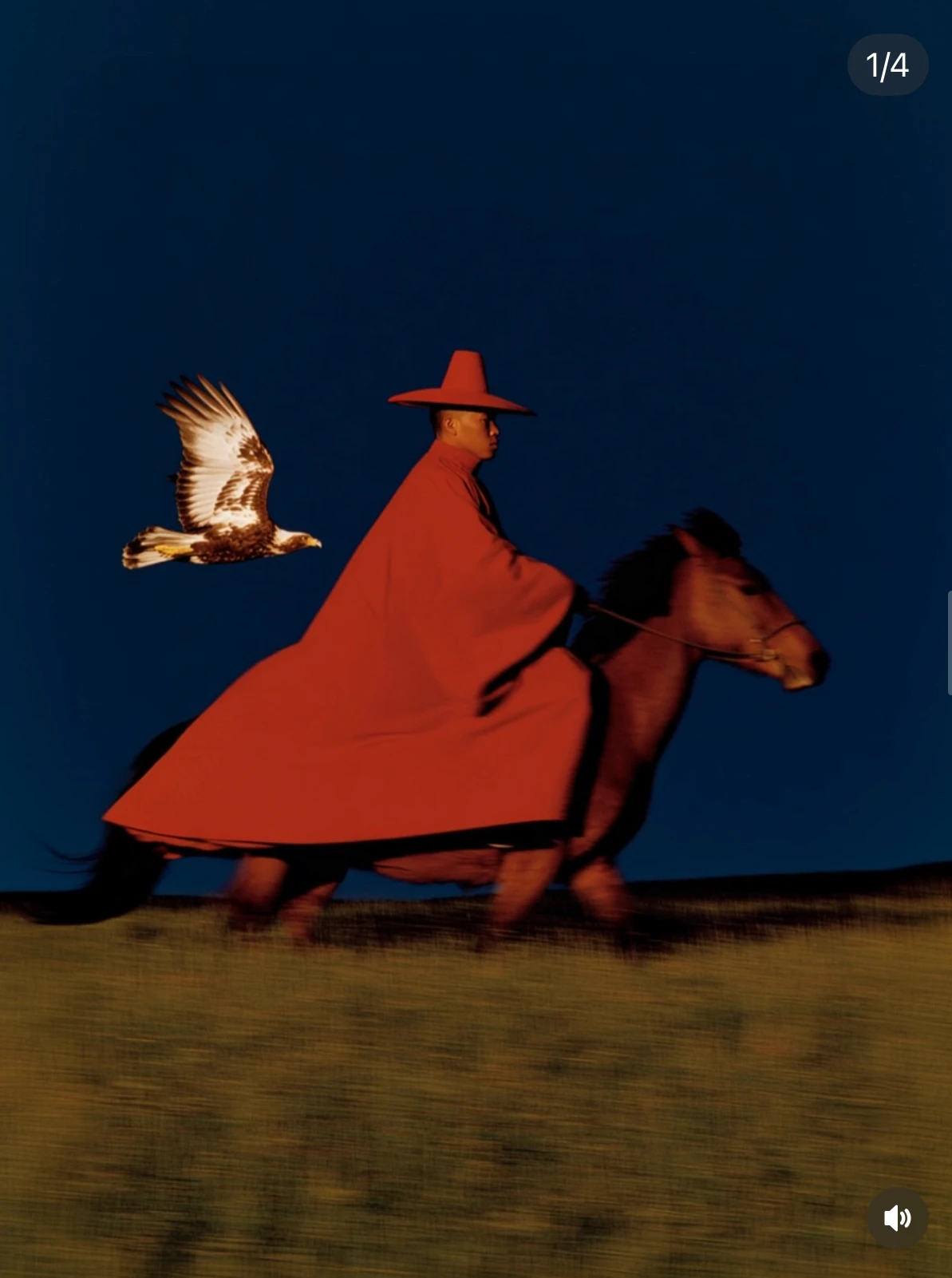
Gizem Akdag Visual Art, Via Instagram
Although in the age of AI art, Sunaina Anand makes an insightful observation, “I believe, in the coming years, ‘human’ art will become a rare commodity, almost a luxury. An artist’s skill will become increasingly valuable. “
THE UPSIDE OF VISIBILITY
Even though for many artists social media has been a constraint, one can’t ignore that it has acted as a catalyst for emerging artists and brands. Labels such as NefFinds, founded by Nefertari Joshi in 2020-21, is a slow homegrown fashion brand in India that began as a thrift store on Instagram, selling summer pieces and clothes, evolving into an e-commerce brand. Farah Siddiqui points out that: “Certainly, visibility can amplify a practice and help connect with fellow artists and curators worldwide.” Meanwhile, Sahil Kochhar adds, “Digital visibility does shape first impressions today. It helps a designer be seen, spoken about, and discovered across geographies. At the same time, I believe real, sustained value on global stages still comes from the integrity of the craft and the depth of the story.” Therefore, digital visibility doesn't acquire the depth of artistic value, yet it can still play a major role in expanding access and connecting artists to wider audiences.
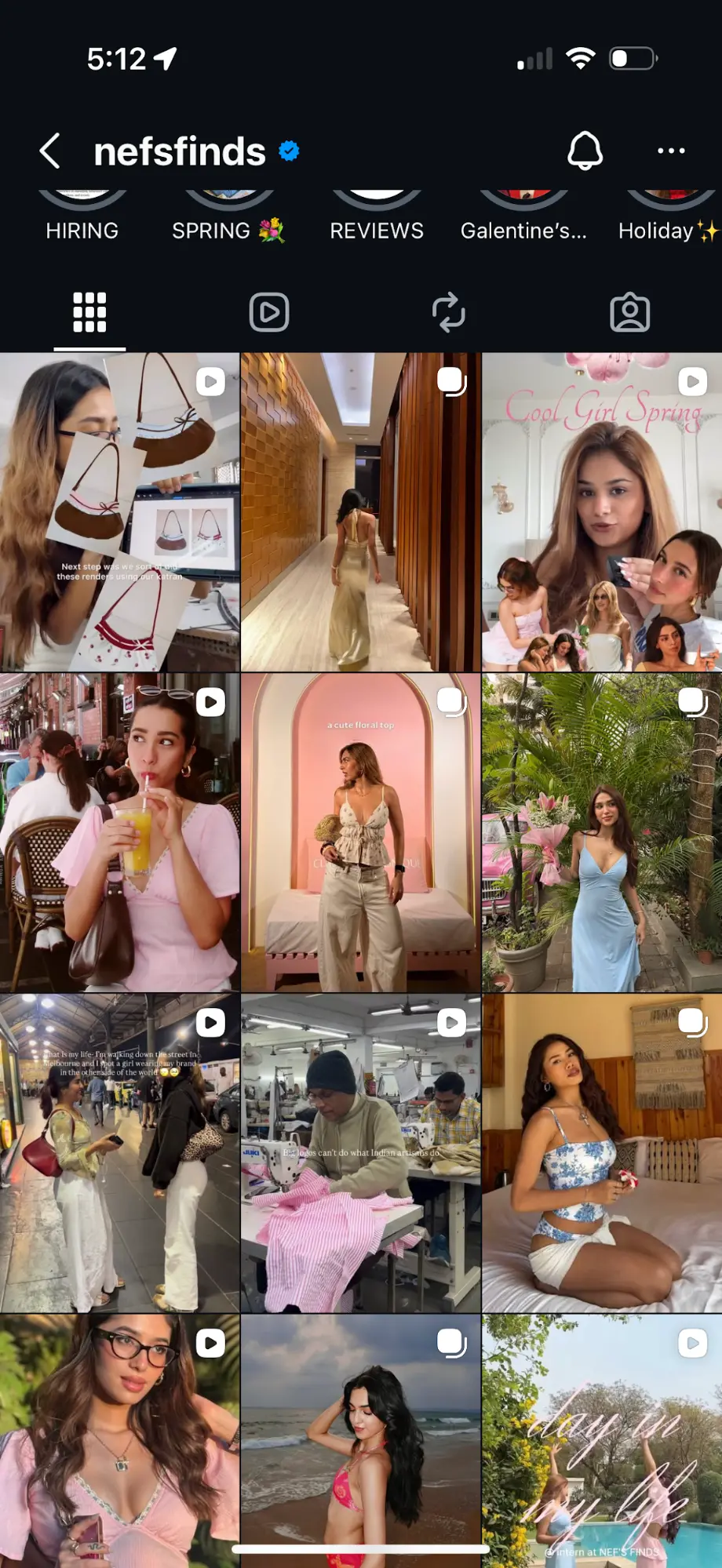
Nef’s Finds Grid// @Nefsfinds
FINDING COMMON GROUND
Ultimately, now there is no going back to the ‘protected silence of the past’; in this landscape, creation is no longer complete without visibility. Art, to a large extent, consciously or unconsciously runs on digital presence. What remains within the artist’s control, however, is how they choose to engage with it. Thus, visibility is not the judge of an artwork, but the condition within which art is bound to exist.
CITATIONS
Artist vs content creator (no date) Dave Lawrence Photography. Available at: https://davelawrence.photo/artist-vs-contentcreator/ (Accessed: April 14, 2026).
Freeman, N. (2021) Virgil Abloh’s Online Presence in the fashion industry, Medium. Available at: https://medium.com/digital-society/virgil-ablohs-
online-presence-in-the-fashion-industry-1e3aa33ec70f (Accessed: April 12, 2026).
(No date) Fastcompany.com. Available at: https://www.fastcompany.com/3058982/how-off-whites-virgil-abloh-uses-social-media-to-teach-and-inspire (Accessed: April 12, 2026)
Kahn, A.M. (2025) Social media: The comparison machine killing artist creativity, Hyperlux Magazine. Available at: https://hyperluxmagazine.com/social-media-the-comparison-machine-killing-artist-creativity/ (Accessed: April 15, 2026).
Metzler, H. and Garcia, D. (2024) “Social drivers and algorithmic mechanisms on digital media,” Perspectives on Psychological Science: A Journal of the Association for Psychological Science, 19(5), pp. 735–748. Available at: https://doi.org/10.1177/17456916231185057.
Published (2016) Paul rand : An Inspiration, Medium. Available at: https://medium.com/canvs/paul-rand-an-inspiration-bde8d2d7bf4a (Accessed: April 11, 2026).
Shah, S. (2024) What you should know about social media algorithms, Medium. Available at: https://medium.com/@SandleenShah/d-40aa510a9f7e (Accessed: April 13, 2026).
TO BE CONTINUED, FOR SUBSCRIBERS ONLY.
This is where the surface ends and the reporting begins.
The complete piece, the full archive, and access to The French Press Circle. Reporting answerable only to its readers.
Already a subscriber ?
Login
Read these on the house, with our compliments.
A selection from the current issue, open to all readers. Read them in full. The rest is one decision away.



There was a time when art existed in silence; written in notebooks, painted in isolation, composed without any audience in mind. Today, that silence is perceived as absence. In a digital environment where prominence indicates reach, the act of creating and the act of being seen have collapsed into one single gesture. The concern is no longer just to create, but to be seen; shifting the focus from presence to relevance.
WHEN VISIBILITY WAS NOT THE POINT
To understand how visibility has become a prerequisite to define creative practice today, it is important to look at the time when it didn't carry the same weight. In earlier artistic contexts, visibility was very much present, but it was detached from the art of creation. Artists such as Franz Kafka and Amrita Sher-Gil created art in environments where visibility did not dictate their artistic practice. Czech-origin writer Franz Kafka is a prime example; he had published only a handful of short writings. For him, writing was a form of prayer, an internal struggle that didn't necessitate the validation of a legacy, let alone an audience.
FRANZ KAFKA
Amrita Sher-Gil, a Hungarian-Indian eminent painter in Indian art history, has created artwork depicting intimate details and the daily lives of women, rooted in global modernity. Her art was deeply introspective, derived from her personal experiences and observations as a woman. Sunaina Anand, the founder and Director of Art Alive Gallery, stated, “It is not just about marketing a commodity well; the true value of art lies in its aesthetics and its power to make an impact.” In this regard, Sher-Gil knew how to make that impact through a body of work built in obscurity, yet enduring in its resonance.
Amrita Sher-Gil Photographed By Umrao Singh Shergill In Paris
Three Little Girls Painting By Amrita Sher-Gil, Image Via Encyclopedia Britannica
VISIBILITY AS CURRENCY
There is a sharp dichotomy when placed against the present, with figures such as the 46-year-old American bestselling author Colleen Hoover. She gained her share of fame through a community created by the Gen-Z audience on TikTok called Booktok. Novels that she had written years ago suddenly entered the bestseller charts, because of the change in visibility rather than the art itself, in this case, her writing, which eventually led her 2016 book It Ends With Us being adapted into a major motion picture: released in over 3611 theatres worldwide, along with grossing over $351 million. At the end of the day, the real question that remains is, if it weren't for BookTok, would she still be as renowned as she is currently?
Colleen Hoover Image Shot By Jasmine Archie; Texas Monthly
Tiktok Screenshot By Maddie Bueyan
Where names like Colleen Hoover represent the artists whose creations catapulted into visibility, Virgil Abloh, Founder of Off-White and Artistic Director of Louis Vuitton, represented something even more complex. Abloh built his creative identity around the concept of design modification, specifically the 3% rule, which centered on his philosophy of altering or refining a product by a mere 3% from its original state. Abloh quoted this at a Harvard lecture in 2017: “Design is like DJing. You take existing sounds, and you recontextualise them”. Abloh blurred the line between being a public icon and an artist. As designer and founder of the homegrown brand HUEMN, Pranav Kirti Misra notes, “Art is bigger than the artist, and the artist is bigger than the stage”. In this case, Abloh’s legacy still lives on, and he knew how to utilise his visibility without letting it overpower his creative prowess.
Virgil Abloh For Baccarat Shot By Bloadkan Plaklov
Off White Fall Winter Ready To Wear Show, Paris, France
ALGORITHMS AS CREATIVE TASTEMAKERS
As a result, algorithms shaping creative value became one of the most contested topics addressed in contemporary art and culture. What was once determined by a gallery curator’s eye, or an editor’s instinct, is increasingly being mediated by the digital engagement metrics dictating what is seen and valued. Farah Siddiqui, art curator and founder of the international platform for emerging artists CultivateArt, observes this shift firsthand. “Algorithms often reward immediacy and repetition, qualities that can conflict with the slower, intuitive nature of meaningful practice. This can lead to work being shaped by visibility rather than necessity, risking a loss of depth”. Trishanu Paul, founder of the fashion digital marketing agency CodetoCouture, also adds, “The algorithm is a powerful validator of popularity, but a terrible validator of legacy. That’s the trap. A professional expert, like an editor or a seasoned buyer, can see the potential in a silhouette that people aren't ready for yet. The algorithm only knows what people already like.”
On the contrary, digital visibility for artists does have its perks and has made the creative foundation more accessible than it was before. Raghava KK, an interdisciplinary artist and tech entrepreneur, named by CNN as one of the ten most remarkable people in 2010, acknowledges this duality: “And for an artist whose entire practice is about holding multiple perspectives simultaneously, that visibility was useful but not formative.” He further suggests that platforms are not neutral systems. Every platform serves its own agenda, and its value lies in how it is strategically used to navigate to one’s advantage rather than for its stated purpose.
WHEN ART BECOMES CONTENT
Moreover, with digital platforms being integral to creative practice, there is a growing ambiguity regarding where one tends to forget the difference between the artist and the content creator, and at times, reducing all forms of artistic creation to content.
Multidisciplinary visual artist and Red Bull World Doodle Art Champion 2014, Santanu Hazarika, distinguishes the two smoothly, making a very relatable statement. “Art, as a final piece, is one thing. Content can be anything. It can be about the art, the process, the story around it.” His observation highlights a crucial difference: art provides substance, while content determines the consumption. In addition, the way both methods are understood so are their valuation systems. Simultaneously, value here operates on two simple levels: one is surface-level and numerical through views and population, and the second is intrinsic, measured through the emotional weight of the work and the depth it carries. Whilst social media amplifies the former, the latter is a measure of abstract factors existing beyond the digital merits.
This creates the divide that the more consumable work is prioritised over work that requires comprehensive insight and attention to detail. Specifically, to understand how design is consumed on digital platforms. A work of art that may be created with precision, with an extensive process behind it, is often diluted to a fleeting visual impression. Delhi-based pret-a-couture designer and founder of his eponymous label, established in 2014, Sahil Kochhar articulates this dynamic: “Social media holds the outline but not that quiet, tactile experience of engaging with the craftsmanship up close”.
THE PRICE OF PERFORMING
The concept of ‘putting yourself out there’ may be a bold move, but when it turns into a necessity, it begins to take a psychological toll. Especially for artists, whose field is codependent on reflection and inward-thinking.
The pressure to remain visible introduces cycles of comparison and self-distortion. Over time, this has led to a series of creative blocks where the focus ends up diverting from making meaningful work to maintaining relevance.
Nidhi Yasha, designer and founder of the haute-couture Bombay-based fashion house The NY Studio, also states from her personal experience that “Earlier, design could exist in a kind of protected silence. Today, it’s expected to perform constantly: to be visible, responsive, almost conversational in real time. But I don’t believe creativity can come from that frequency.”
Certain artists somehow end up adapting their pace to what is more likely to be seen than to what speaks to them. As Santanu Hazarika observes, “Artists don’t burn out making art anymore; they burn out making content.”
THE OWNERSHIP CRISIS IN ART
More significantly, even with the rise of AI, this issue has escalated. Even if an artist chooses to stay off the grid, the fear of their work being ripped off or used for publicity is paramount now. This has been underscored by Delhi-based contemporary artist Abhay Sehgal, who was not only accused but exposed by visual artist and illustrator Krishna Bala Shenoi of passing off AI-generated collages from uncredited painters as original oil paintings. Sehgal leveraged his platform and gained success on social media through performing the role of an artist by using his Instagram to present algorithmic output as his own work. In a digital vacuum, if one is not present to claim their intellectual and artistic property, there is a high risk of it being imitated and stolen – whether by an LLM or one’s own creative fraternity.
On the other hand, there are exceptions to every rule, Turkish AI artist Gizem Akdag being one. She uses technology productively to build surreal narratives. She uses AI as an option, proving it can be a creative partner, rather than just a shortcut.
Gizem Akdag Visual Art, Via Instagram
Although in the age of AI art, Sunaina Anand makes an insightful observation, “I believe, in the coming years, ‘human’ art will become a rare commodity, almost a luxury. An artist’s skill will become increasingly valuable. “
THE UPSIDE OF VISIBILITY
Even though for many artists social media has been a constraint, one can’t ignore that it has acted as a catalyst for emerging artists and brands. Labels such as NefFinds, founded by Nefertari Joshi in 2020-21, is a slow homegrown fashion brand in India that began as a thrift store on Instagram, selling summer pieces and clothes, evolving into an e-commerce brand. Farah Siddiqui points out that: “Certainly, visibility can amplify a practice and help connect with fellow artists and curators worldwide.” Meanwhile, Sahil Kochhar adds, “Digital visibility does shape first impressions today. It helps a designer be seen, spoken about, and discovered across geographies. At the same time, I believe real, sustained value on global stages still comes from the integrity of the craft and the depth of the story.” Therefore, digital visibility doesn't acquire the depth of artistic value, yet it can still play a major role in expanding access and connecting artists to wider audiences.
Nef’s Finds Grid// @Nefsfinds
FINDING COMMON GROUND
Ultimately, now there is no going back to the ‘protected silence of the past’; in this landscape, creation is no longer complete without visibility. Art, to a large extent, consciously or unconsciously runs on digital presence. What remains within the artist’s control, however, is how they choose to engage with it. Thus, visibility is not the judge of an artwork, but the condition within which art is bound to exist.
CITATIONS
Artist vs content creator (no date) Dave Lawrence Photography. Available at: https://davelawrence.photo/artist-vs-contentcreator/ (Accessed: April 14, 2026).
Freeman, N. (2021) Virgil Abloh’s Online Presence in the fashion industry, Medium. Available at: https://medium.com/digital-society/virgil-ablohs-
online-presence-in-the-fashion-industry-1e3aa33ec70f (Accessed: April 12, 2026).
(No date) Fastcompany.com. Available at: https://www.fastcompany.com/3058982/how-off-whites-virgil-abloh-uses-social-media-to-teach-and-inspire (Accessed: April 12, 2026)
Kahn, A.M. (2025) Social media: The comparison machine killing artist creativity, Hyperlux Magazine. Available at: https://hyperluxmagazine.com/social-media-the-comparison-machine-killing-artist-creativity/ (Accessed: April 15, 2026).
Metzler, H. and Garcia, D. (2024) “Social drivers and algorithmic mechanisms on digital media,” Perspectives on Psychological Science: A Journal of the Association for Psychological Science, 19(5), pp. 735–748. Available at: https://doi.org/10.1177/17456916231185057.
Published (2016) Paul rand : An Inspiration, Medium. Available at: https://medium.com/canvs/paul-rand-an-inspiration-bde8d2d7bf4a (Accessed: April 11, 2026).
Shah, S. (2024) What you should know about social media algorithms, Medium. Available at: https://medium.com/@SandleenShah/d-40aa510a9f7e (Accessed: April 13, 2026).
TO BE CONTINUED, FOR SUBSCRIBERS ONLY.
This is where the surface ends and the reporting begins.
The complete piece, the full archive, and access to The French Press Circle. Reporting answerable only to its readers.
Already a subscriber ?
Login
Read these on the house, with our compliments.
A selection from the current issue, open to all readers. Read them in full. The rest is one decision away.