Let us be honest with ourselves, even when the truth is uncomfortable.
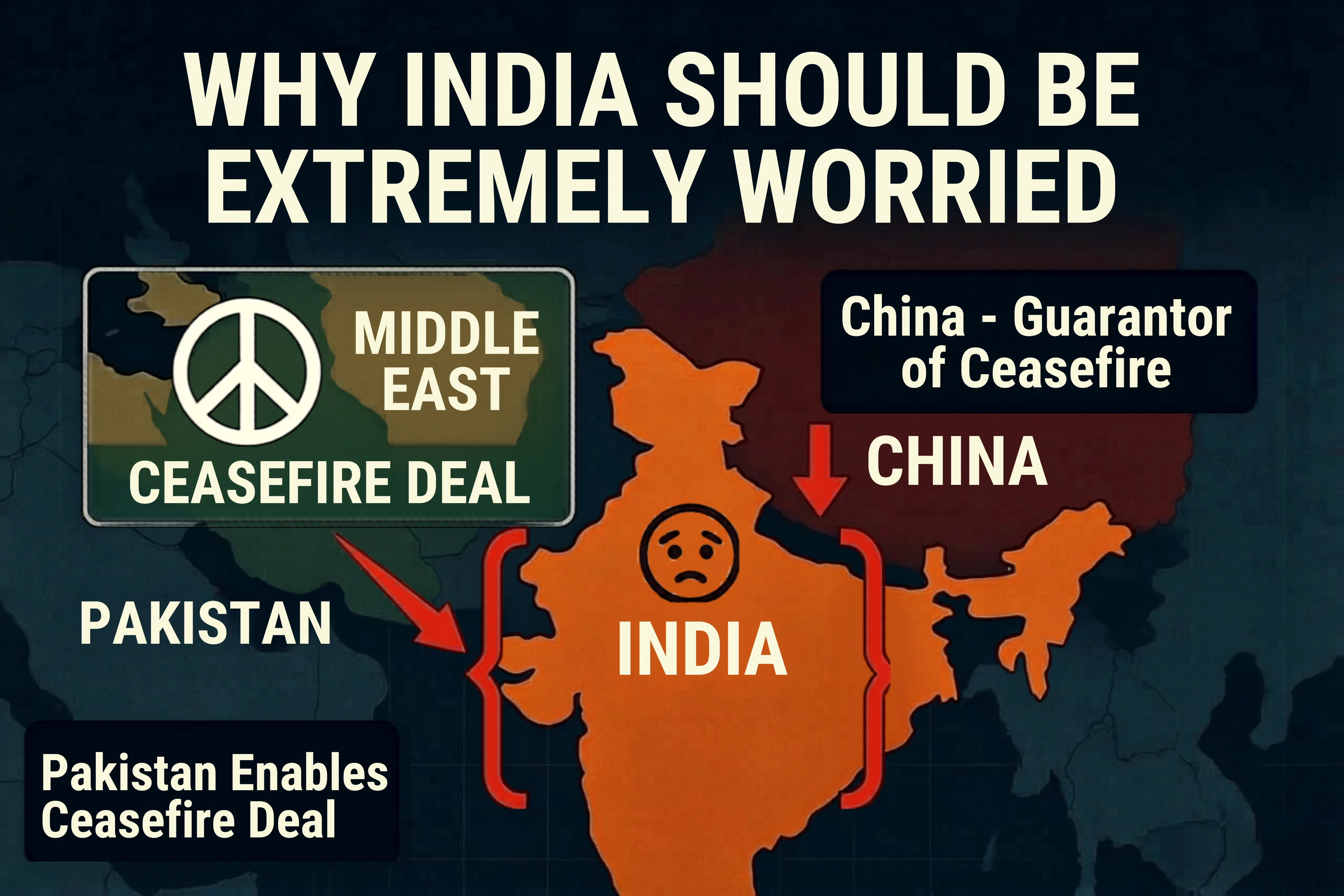
On April 8, less than two hours before Donald Trump's self-imposed deadline to destroy Iran's "entire civilisation," Pakistan brokered a two-week ceasefire between Washington and Tehran. The world exhaled. India held its breath. In reckoning.
Because what unfolded was a tectonic shift in the architecture of global power. At the center of that shift stand two nations that share borders with India, one that brokered the deal, one whose last-minute intervention made it possible.
Pakistan. And China.
Let that sit for a moment.
The Architecture of the Deal
Field Marshal Asim Munir, elevated to that extraordinary rank after the four-day conflict with India in May 2025, was the critical back-channel between Washington and Tehran. The ceasefire was negotiated between Munir, US Vice President JD Vance, special envoy Steve Witkoff, and Iranian Foreign Minister Abbas Araghchi. Trump has praised Munir publicly and hosted him for an unprecedented lunch in Washington. The same man who commands a nuclear arsenal pointed at India is now shaping peace agreements that will redraw the Middle East.
China's role was more discreet, and more consequential. According to three Iranian officials cited by the New York Times, Beijing made a last-minute push that persuaded Tehran to show flexibility, a claim Trump himself validated. Pakistani Prime Minister Shehbaz Sharif's gratitude was telling: in his announcement to the world, he listed China first, before Saudi Arabia, Turkey, Egypt, and Qatar.
This is not diplomacy as usual. This is a new world order, drafted without India in the room.
Pakistan has become Beijing's chosen instrument of international influence, and Washington courts it shamelessly.
The Geometry of Encirclement
For decades, India has understood its strategic reality in binary terms: a hostile Pakistan to the west, an assertive China to the north and east. What is newer, and more dangerous, is the effortless, coordinated fluency with which these two actors now operate together on the global stage.
The China-Pakistan partnership has graduated from a regional irritant to a global diplomatic force. Pakistan is now Beijing's chosen instrument of international influence, and Washington courts it shamelessly.
India rejected Trump's claim that he brokered the India-Pakistan ceasefire last May. Pakistan embraced it. That single divergence in diplomatic optics, seemingly minor at the time, opened a direct channel between Munir and the White House that Pakistan has now leveraged into a historic mediating role. Pakistan's transformation is a 180-degree turn from three decades of being branded the world's "terror factory." India spent those three decades making that case. In one stunning diplomatic act, Islamabad has rewritten its own narrative.
New Delhi's foreign policy establishment would do well to sit with the weight of that failure.
What China's Role Actually Means
We must not be naive about Beijing's motivations. China backed this ceasefire because it needed to stabilise a region critical to its energy flows, and to preserve its diplomatic standing, particularly if Iran receives sanctions relief. This is entirely self-serving. And entirely rational.
But the consequences extend far beyond the Strait of Hormuz.
A China that is the decisive actor behind Middle Eastern peace is a China that controls the levers of a region India depends upon for the overwhelming majority of its energy imports. India needs the Strait open. And it is China that holds the key.
This is strategic leverage of an extraordinary kind. If tomorrow India and China face a confrontation (over Arunachal Pradesh, over the LAC, over Taiwan's ripple effects), Beijing now has a hand on the energy tap that feeds the Indian economy. That is the architecture of coercion.
Strategic autonomy requires strategic presence. This week, India was absent entirely.
The Erosion of India's Strategic Autonomy
India has long prided itself on strategic autonomy, the ability to navigate great power rivalries without choosing sides. It has cultivated Washington, Moscow, and the Gulf simultaneously. It has been the voice of the Global South while deepening defence ties with Israel, France, and Japan. This has been, on balance, a sophisticated and largely successful posture.
The choice of Pakistan as mediator reflects a brutal logic: in a moment of global crisis, usefulness matters more than size, more than democracy, more than moral standing. India, despite its economy, its diaspora in the Gulf, and its democratic credentials, was not useful to anyone in this moment.
Meanwhile, Pakistan's defence budget has risen to $9 billion, a 20 percent increase, supported heavily by China, with its arms industry transitioning from assembly to indigenous design. It possesses an estimated 170 nuclear warheads, a doctrine of deliberate first-use ambiguity, and tactical nuclear weapons that lower the threshold of potential conflict. This is the country that just brokered a peace deal for the world.
Should India Be Scared?
I will not dress this in the comfortable language of diplomatic caution. Yes. India should be deeply, structurally concerned.
The ceasefire itself is not the revelation. The world it has exposed is. The international order is being reorganised around utility, around energy, around transactional power, and China and Pakistan have positioned themselves at the intersection of all three.
India's foreign policy needs an urgent reset, one born of clarity. New Delhi must deepen its presence in the Gulf far more aggressively, leveraging its nine-million strong diaspora and its growing economic weight. It must stop treating its diplomatic defeats as footnotes and start treating them as signals.
The Islamabad ceasefire, if it holds, will be taught in foreign policy schools for a generation. It will be remembered as the moment Pakistan and China jointly redrew the rules of regional influence, with Washington's blessing and the world's attention. India was a spectator.
The question is whether it intends to be in the next one.
EDITOR'S NOTE · BREAKING
As this editorial publishes, the Islamabad peace talks have collapsed. JD Vance departed Pakistan on April 12 without a deal, and Trump has threatened a full naval blockade on Iran. The ceasefire is hanging by a thread. The geopolitical argument made in this piece is more urgent as a result.
TO BE CONTINUED, FOR SUBSCRIBERS ONLY.
This is where the surface ends and the reporting begins.
The complete piece, the full archive, and access to The French Press Circle. Reporting answerable only to its readers.
Already a subscriber ?
Login
Read these on the house, with our compliments.
A selection from the current issue, open to all readers. Read them in full. The rest is one decision away.










Let us be honest with ourselves, even when the truth is uncomfortable.
On April 8, less than two hours before Donald Trump's self-imposed deadline to destroy Iran's "entire civilisation," Pakistan brokered a two-week ceasefire between Washington and Tehran. The world exhaled. India held its breath. In reckoning.
Because what unfolded was a tectonic shift in the architecture of global power. At the center of that shift stand two nations that share borders with India, one that brokered the deal, one whose last-minute intervention made it possible.
Pakistan. And China.
Let that sit for a moment.
The Architecture of the Deal
Field Marshal Asim Munir, elevated to that extraordinary rank after the four-day conflict with India in May 2025, was the critical back-channel between Washington and Tehran. The ceasefire was negotiated between Munir, US Vice President JD Vance, special envoy Steve Witkoff, and Iranian Foreign Minister Abbas Araghchi. Trump has praised Munir publicly and hosted him for an unprecedented lunch in Washington. The same man who commands a nuclear arsenal pointed at India is now shaping peace agreements that will redraw the Middle East.
China's role was more discreet, and more consequential. According to three Iranian officials cited by the New York Times, Beijing made a last-minute push that persuaded Tehran to show flexibility, a claim Trump himself validated. Pakistani Prime Minister Shehbaz Sharif's gratitude was telling: in his announcement to the world, he listed China first, before Saudi Arabia, Turkey, Egypt, and Qatar.
This is not diplomacy as usual. This is a new world order, drafted without India in the room.
Pakistan has become Beijing's chosen instrument of international influence, and Washington courts it shamelessly.
The Geometry of Encirclement
For decades, India has understood its strategic reality in binary terms: a hostile Pakistan to the west, an assertive China to the north and east. What is newer, and more dangerous, is the effortless, coordinated fluency with which these two actors now operate together on the global stage.
The China-Pakistan partnership has graduated from a regional irritant to a global diplomatic force. Pakistan is now Beijing's chosen instrument of international influence, and Washington courts it shamelessly.
India rejected Trump's claim that he brokered the India-Pakistan ceasefire last May. Pakistan embraced it. That single divergence in diplomatic optics, seemingly minor at the time, opened a direct channel between Munir and the White House that Pakistan has now leveraged into a historic mediating role. Pakistan's transformation is a 180-degree turn from three decades of being branded the world's "terror factory." India spent those three decades making that case. In one stunning diplomatic act, Islamabad has rewritten its own narrative.
New Delhi's foreign policy establishment would do well to sit with the weight of that failure.
What China's Role Actually Means
We must not be naive about Beijing's motivations. China backed this ceasefire because it needed to stabilise a region critical to its energy flows, and to preserve its diplomatic standing, particularly if Iran receives sanctions relief. This is entirely self-serving. And entirely rational.
But the consequences extend far beyond the Strait of Hormuz.
A China that is the decisive actor behind Middle Eastern peace is a China that controls the levers of a region India depends upon for the overwhelming majority of its energy imports. India needs the Strait open. And it is China that holds the key.
This is strategic leverage of an extraordinary kind. If tomorrow India and China face a confrontation (over Arunachal Pradesh, over the LAC, over Taiwan's ripple effects), Beijing now has a hand on the energy tap that feeds the Indian economy. That is the architecture of coercion.
Strategic autonomy requires strategic presence. This week, India was absent entirely.
The Erosion of India's Strategic Autonomy
India has long prided itself on strategic autonomy, the ability to navigate great power rivalries without choosing sides. It has cultivated Washington, Moscow, and the Gulf simultaneously. It has been the voice of the Global South while deepening defence ties with Israel, France, and Japan. This has been, on balance, a sophisticated and largely successful posture.
The choice of Pakistan as mediator reflects a brutal logic: in a moment of global crisis, usefulness matters more than size, more than democracy, more than moral standing. India, despite its economy, its diaspora in the Gulf, and its democratic credentials, was not useful to anyone in this moment.
Meanwhile, Pakistan's defence budget has risen to $9 billion, a 20 percent increase, supported heavily by China, with its arms industry transitioning from assembly to indigenous design. It possesses an estimated 170 nuclear warheads, a doctrine of deliberate first-use ambiguity, and tactical nuclear weapons that lower the threshold of potential conflict. This is the country that just brokered a peace deal for the world.
Should India Be Scared?
I will not dress this in the comfortable language of diplomatic caution. Yes. India should be deeply, structurally concerned.
The ceasefire itself is not the revelation. The world it has exposed is. The international order is being reorganised around utility, around energy, around transactional power, and China and Pakistan have positioned themselves at the intersection of all three.
India's foreign policy needs an urgent reset, one born of clarity. New Delhi must deepen its presence in the Gulf far more aggressively, leveraging its nine-million strong diaspora and its growing economic weight. It must stop treating its diplomatic defeats as footnotes and start treating them as signals.
The Islamabad ceasefire, if it holds, will be taught in foreign policy schools for a generation. It will be remembered as the moment Pakistan and China jointly redrew the rules of regional influence, with Washington's blessing and the world's attention. India was a spectator.
The question is whether it intends to be in the next one.
EDITOR'S NOTE · BREAKING
As this editorial publishes, the Islamabad peace talks have collapsed. JD Vance departed Pakistan on April 12 without a deal, and Trump has threatened a full naval blockade on Iran. The ceasefire is hanging by a thread. The geopolitical argument made in this piece is more urgent as a result.
TO BE CONTINUED, FOR SUBSCRIBERS ONLY.
This is where the surface ends and the reporting begins.
The complete piece, the full archive, and access to The French Press Circle. Reporting answerable only to its readers.
Already a subscriber ?
Login
Read these on the house, with our compliments.
A selection from the current issue, open to all readers. Read them in full. The rest is one decision away.