Let me tell you what happened this week, in case you missed it between the outrage cycles.
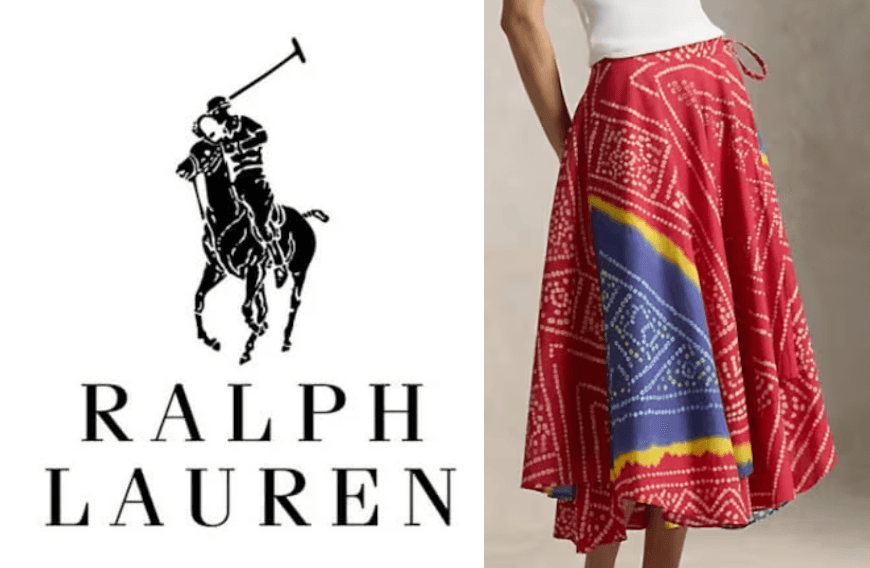
Ralph Lauren listed a printed cotton wrap skirt on its website, described as inspired by Bandhani tie-dye techniques, priced at approximately ₹44,800. Within hours, social media had declared war. “Chor.” “Thieves.” “The British East India Company did the same thing.” One particularly furious influencer pointed out that a hand-done Bandhani skirt in India costs less than ₹5,000. The internet, true to form, lost its collective mind. I haven’t. And here is why.
First… let’s talk about what Bandhani actually is. Because if you’re going to be outraged about it, you should at least know it.
Bandhani is one of the oldest textile traditions on the planet. The word comes from the Sanskrit bandh, which means, to tie. The craft dates back to the Indus Valley Civilisation, around 4000 BC. The earliest visual evidence appears in the 6th-century paintings on the walls of Cave 1 at Ajanta, depicting the life of Buddha… those extraordinary dotted patterns already fully formed, already dazzling, already unmistakably Indian. Alexander the Great’s armies reportedly remarked on India’s dyed cotton when they came through. That is how old this craft is. It predates most of the civilisations whose fashion houses are now apparently stealing from it.
Bandhani is made by pinching tiny portions of fabric and tying them tightly with thread before dyeing - thousands of knots in a single metre of cloth, each one placed by hand, often by the women of Khatri community households in Gujarat’s Kutch and Saurashtra regions and across Rajasthan’s Jaipur, Udaipur, Jodhpur, and Bikaner. The knots resist the dye and when untied, they reveal the characteristic dotted patterns - Boond, Mothra, Ekdali, Shikari, Leheriya - in colours that historically carried meaning. Red for marriage. Yellow for new mothers. The Gharchola saree, a Bandhani weave gifted by a mother-in-law to her new bride, is among the most sacred objects in a Gujarati wedding. This is representative of ritual, ancestry, and six thousand years of human ingenuity tied into tiny knots by the fingernails of women whose names no one has ever written down.
It is, in a word, staggering. And the fact that Ralph Lauren found it beautiful enough to be inspired by? I am genuinely, wholeheartedly, unambiguously flattered on India’s behalf.
Here is my honest position, and I will stand by it.
Ralph Lauren took inspiration from one of the most magnificent textile traditions in human history and put it on a skirt. They called it “inspired by Bandhani techniques.” They named the craft. What followed was was influence. And influence, at its most fundamental, is how culture moves through the world.
I genuinely do not understand why we are so reactive every single time this happens. What exactly is the expectation? That every time a global brand finds India inspiring, they file a cultural declaration, credit every ancestor, and tag the artisan’s village in their product description? Come on. Do we require that of ourselves when we are inspired?
Because let’s have that conversation too… the one we conveniently skip in these moments of national outrage. Mumbai’s skyline is a love letter to Art Deco, borrowed wholesale from 1930s Europe. Our most prestigious hotels are architectural pastiches of colonial grandeur. Indian fashion designers have spent decades working in silhouettes drawn entirely from Western tailoring traditions - the blazer, the trouser, the A-line dress, the bomber jacket - and calling it contemporary Indian fashion. Sabyasachi built part of his early brand equity on a very specific Victorian-era romantic aesthetic. Our interiors are full of Scandinavian minimalism, Moroccan tiles, and mid-century American furniture. Nobody is calling any of that theft. Because it isn’t. It is the entirely natural, entirely beautiful result of a globalised world where aesthetics travel and cross-pollinate and produce something new.
And this is a very old story.
Western fashion has been drawing from India for centuries - literally. High fashion’s relationship with Indian craft goes back to at least the 17th century, when Europe’s royal tailors were already seeking out Indian silk and cotton. Chintz. Paisley. Both deeply Indian in origin, both now so thoroughly absorbed into the Western design vocabulary that their provenance has been all but forgotten.
Nobody is rioting about paisley.
More recently, and more visibly - the record is mixed, instructive, and genuinely worth examining without hysteria. In June 2025, Prada unveiled sandals at Milan Fashion Week that bore a striking resemblance to Kolhapuri chappals - the centuries-old handcrafted leather footwear from Maharashtra, GI-tagged since 2019 and priced them at ₹1 lakh, against the original’s ₹1,000, without any attribution whatsoever. They initially called them simply “leather sandals,” as though the design had arrived from nowhere. That was a failure of acknowledgment that warranted the pushback it received. To their credit, after sustained pressure, Prada acknowledged the inspiration and committed to dialogue with artisan communities. Good.
Dior, by contrast, got it right. Their 2023 Pre-Fall show at the Gateway of India - Banarasi brocade, mirror work, Nehru collars, kurta tailoring on a Paris couture runway credited the Mumbai atelier Chanakya International prominently, whose embroiderers had crafted much of the collection. Prominent stylist Anaita Shroff Adajania called it “a thank you to India.” It was exactly that.
Gucci in 2019 put a Sikh-style turban on the runway and sold it for $790 at Nordstrom without context or community conversation - that was tone-deaf and deserved its backlash.
Balenciaga turned a Bengali-Bihar jute weave into an ₹85,000 tote and called it eco-chic without a word about its origins - that merited being called out. Dior commissioned a $200,000 Mukaish embroidery overcoat in 2025, drawn from Lucknow’s gold wire tradition, and initially offered no credit to the Indian hands that made it and that is worth questioning.
But Ralph Lauren called the technique by its name. They said Bandhani. They did not pretend the aesthetic emerged from a vacuum. Is the price markup obscene relative to what an artisan earns? Absolutely, and that is a conversation worth having - not just with Ralph Lauren but with the entire global luxury supply chain that sources from India at cost prices the original makers can barely survive on. That is the real structural injustice, and it is far more important than a printed skirt.
The GI tagging conversation, though - that one I’ll take seriously.
India currently has 658 GI-tagged products. Bandhani already has GI recognition, as does the Kolhapuri chappal. The problem, as the Prada case exposed, is that India’s GI protections are geographically limited as they prevent misuse of the name within India but offer very limited recourse when a foreign brand replicates the aesthetic internationally without using the protected name. That is a genuine policy gap worth pursuing aggressively at WIPO and in bilateral trade negotiations. If there is a legacy craft with artisan communities who depend on it for their livelihoods, GI protection strengthened to international enforceability is a legitimate and important tool. Pursue that. Legislate it. Fight for it at every multilateral forum.
But that is a policy argument. It is not the same as declaring Ralph Lauren criminals on X.
Here is what I actually want us to do instead.
Celebrate. Loudly, confidently, and from a position of complete security. The world’s most recognisable luxury brands keep coming back to India… to Bandhani, to Kolhapuri leather, to Mukaish embroidery, to Banarasi brocade, to Lucknow’s chikankari, to the block printing of Rajasthan, to the handlooms of Bengal and Assam and Karnataka because Indian craft is extraordinary. It has been extraordinary for six thousand years.
The Ajanta Cave paintings were documenting Bandhani dotted patterns while most of Europe was still figuring out the wheel.
The fact that Ralph Lauren looked at a Gujarati textile tradition and found it worthy of a global collection is, if you can step back from the outrage long enough to see it clearly, an extraordinary compliment to the depth and beauty of what India has built over millennia.
We are not a culture that can be depleted by inspiration. Bandhani was here before the Mughals, before the British, before globalisation, before the internet, before every luxury house that has ever looked to India for ideas. It will be here long after all of them. The Khatri women of Kutch are still tying their thousands of tiny knots. The craft lives. The culture is intact.
The only thing we risk losing is our own confidence in it - when we respond with fury, when we treat every act of global inspiration as an act of war, when we position ourselves as victims of our own magnificence.
India is the original. Imitation is the sincerest form of flattery. And six thousand years of Bandhani doesn’t need our defence.
It needs our pride.
TO BE CONTINUED, FOR SUBSCRIBERS ONLY.
This is where the surface ends and the reporting begins.
The complete piece, the full archive, and access to The French Press Circle. Reporting answerable only to its readers.
Already a subscriber ?
Login
Read these on the house, with our compliments.
A selection from the current issue, open to all readers. Read them in full. The rest is one decision away.



Let me tell you what happened this week, in case you missed it between the outrage cycles.
Ralph Lauren listed a printed cotton wrap skirt on its website, described as inspired by Bandhani tie-dye techniques, priced at approximately ₹44,800. Within hours, social media had declared war. “Chor.” “Thieves.” “The British East India Company did the same thing.” One particularly furious influencer pointed out that a hand-done Bandhani skirt in India costs less than ₹5,000. The internet, true to form, lost its collective mind. I haven’t. And here is why.
First… let’s talk about what Bandhani actually is. Because if you’re going to be outraged about it, you should at least know it.
Bandhani is one of the oldest textile traditions on the planet. The word comes from the Sanskrit bandh, which means, to tie. The craft dates back to the Indus Valley Civilisation, around 4000 BC. The earliest visual evidence appears in the 6th-century paintings on the walls of Cave 1 at Ajanta, depicting the life of Buddha… those extraordinary dotted patterns already fully formed, already dazzling, already unmistakably Indian. Alexander the Great’s armies reportedly remarked on India’s dyed cotton when they came through. That is how old this craft is. It predates most of the civilisations whose fashion houses are now apparently stealing from it.
Bandhani is made by pinching tiny portions of fabric and tying them tightly with thread before dyeing - thousands of knots in a single metre of cloth, each one placed by hand, often by the women of Khatri community households in Gujarat’s Kutch and Saurashtra regions and across Rajasthan’s Jaipur, Udaipur, Jodhpur, and Bikaner. The knots resist the dye and when untied, they reveal the characteristic dotted patterns - Boond, Mothra, Ekdali, Shikari, Leheriya - in colours that historically carried meaning. Red for marriage. Yellow for new mothers. The Gharchola saree, a Bandhani weave gifted by a mother-in-law to her new bride, is among the most sacred objects in a Gujarati wedding. This is representative of ritual, ancestry, and six thousand years of human ingenuity tied into tiny knots by the fingernails of women whose names no one has ever written down.
It is, in a word, staggering. And the fact that Ralph Lauren found it beautiful enough to be inspired by? I am genuinely, wholeheartedly, unambiguously flattered on India’s behalf.
Here is my honest position, and I will stand by it.
Ralph Lauren took inspiration from one of the most magnificent textile traditions in human history and put it on a skirt. They called it “inspired by Bandhani techniques.” They named the craft. What followed was was influence. And influence, at its most fundamental, is how culture moves through the world.
I genuinely do not understand why we are so reactive every single time this happens. What exactly is the expectation? That every time a global brand finds India inspiring, they file a cultural declaration, credit every ancestor, and tag the artisan’s village in their product description? Come on. Do we require that of ourselves when we are inspired?
Because let’s have that conversation too… the one we conveniently skip in these moments of national outrage. Mumbai’s skyline is a love letter to Art Deco, borrowed wholesale from 1930s Europe. Our most prestigious hotels are architectural pastiches of colonial grandeur. Indian fashion designers have spent decades working in silhouettes drawn entirely from Western tailoring traditions - the blazer, the trouser, the A-line dress, the bomber jacket - and calling it contemporary Indian fashion. Sabyasachi built part of his early brand equity on a very specific Victorian-era romantic aesthetic. Our interiors are full of Scandinavian minimalism, Moroccan tiles, and mid-century American furniture. Nobody is calling any of that theft. Because it isn’t. It is the entirely natural, entirely beautiful result of a globalised world where aesthetics travel and cross-pollinate and produce something new.
And this is a very old story.
Western fashion has been drawing from India for centuries - literally. High fashion’s relationship with Indian craft goes back to at least the 17th century, when Europe’s royal tailors were already seeking out Indian silk and cotton. Chintz. Paisley. Both deeply Indian in origin, both now so thoroughly absorbed into the Western design vocabulary that their provenance has been all but forgotten.
Nobody is rioting about paisley.
More recently, and more visibly - the record is mixed, instructive, and genuinely worth examining without hysteria. In June 2025, Prada unveiled sandals at Milan Fashion Week that bore a striking resemblance to Kolhapuri chappals - the centuries-old handcrafted leather footwear from Maharashtra, GI-tagged since 2019 and priced them at ₹1 lakh, against the original’s ₹1,000, without any attribution whatsoever. They initially called them simply “leather sandals,” as though the design had arrived from nowhere. That was a failure of acknowledgment that warranted the pushback it received. To their credit, after sustained pressure, Prada acknowledged the inspiration and committed to dialogue with artisan communities. Good.
Dior, by contrast, got it right. Their 2023 Pre-Fall show at the Gateway of India - Banarasi brocade, mirror work, Nehru collars, kurta tailoring on a Paris couture runway credited the Mumbai atelier Chanakya International prominently, whose embroiderers had crafted much of the collection. Prominent stylist Anaita Shroff Adajania called it “a thank you to India.” It was exactly that.
Gucci in 2019 put a Sikh-style turban on the runway and sold it for $790 at Nordstrom without context or community conversation - that was tone-deaf and deserved its backlash.
Balenciaga turned a Bengali-Bihar jute weave into an ₹85,000 tote and called it eco-chic without a word about its origins - that merited being called out. Dior commissioned a $200,000 Mukaish embroidery overcoat in 2025, drawn from Lucknow’s gold wire tradition, and initially offered no credit to the Indian hands that made it and that is worth questioning.
But Ralph Lauren called the technique by its name. They said Bandhani. They did not pretend the aesthetic emerged from a vacuum. Is the price markup obscene relative to what an artisan earns? Absolutely, and that is a conversation worth having - not just with Ralph Lauren but with the entire global luxury supply chain that sources from India at cost prices the original makers can barely survive on. That is the real structural injustice, and it is far more important than a printed skirt.
The GI tagging conversation, though - that one I’ll take seriously.
India currently has 658 GI-tagged products. Bandhani already has GI recognition, as does the Kolhapuri chappal. The problem, as the Prada case exposed, is that India’s GI protections are geographically limited as they prevent misuse of the name within India but offer very limited recourse when a foreign brand replicates the aesthetic internationally without using the protected name. That is a genuine policy gap worth pursuing aggressively at WIPO and in bilateral trade negotiations. If there is a legacy craft with artisan communities who depend on it for their livelihoods, GI protection strengthened to international enforceability is a legitimate and important tool. Pursue that. Legislate it. Fight for it at every multilateral forum.
But that is a policy argument. It is not the same as declaring Ralph Lauren criminals on X.
Here is what I actually want us to do instead.
Celebrate. Loudly, confidently, and from a position of complete security. The world’s most recognisable luxury brands keep coming back to India… to Bandhani, to Kolhapuri leather, to Mukaish embroidery, to Banarasi brocade, to Lucknow’s chikankari, to the block printing of Rajasthan, to the handlooms of Bengal and Assam and Karnataka because Indian craft is extraordinary. It has been extraordinary for six thousand years.
The Ajanta Cave paintings were documenting Bandhani dotted patterns while most of Europe was still figuring out the wheel.
The fact that Ralph Lauren looked at a Gujarati textile tradition and found it worthy of a global collection is, if you can step back from the outrage long enough to see it clearly, an extraordinary compliment to the depth and beauty of what India has built over millennia.
We are not a culture that can be depleted by inspiration. Bandhani was here before the Mughals, before the British, before globalisation, before the internet, before every luxury house that has ever looked to India for ideas. It will be here long after all of them. The Khatri women of Kutch are still tying their thousands of tiny knots. The craft lives. The culture is intact.
The only thing we risk losing is our own confidence in it - when we respond with fury, when we treat every act of global inspiration as an act of war, when we position ourselves as victims of our own magnificence.
India is the original. Imitation is the sincerest form of flattery. And six thousand years of Bandhani doesn’t need our defence.
It needs our pride.
TO BE CONTINUED, FOR SUBSCRIBERS ONLY.
This is where the surface ends and the reporting begins.
The complete piece, the full archive, and access to The French Press Circle. Reporting answerable only to its readers.
Already a subscriber ?
Login
Read these on the house, with our compliments.
A selection from the current issue, open to all readers. Read them in full. The rest is one decision away.