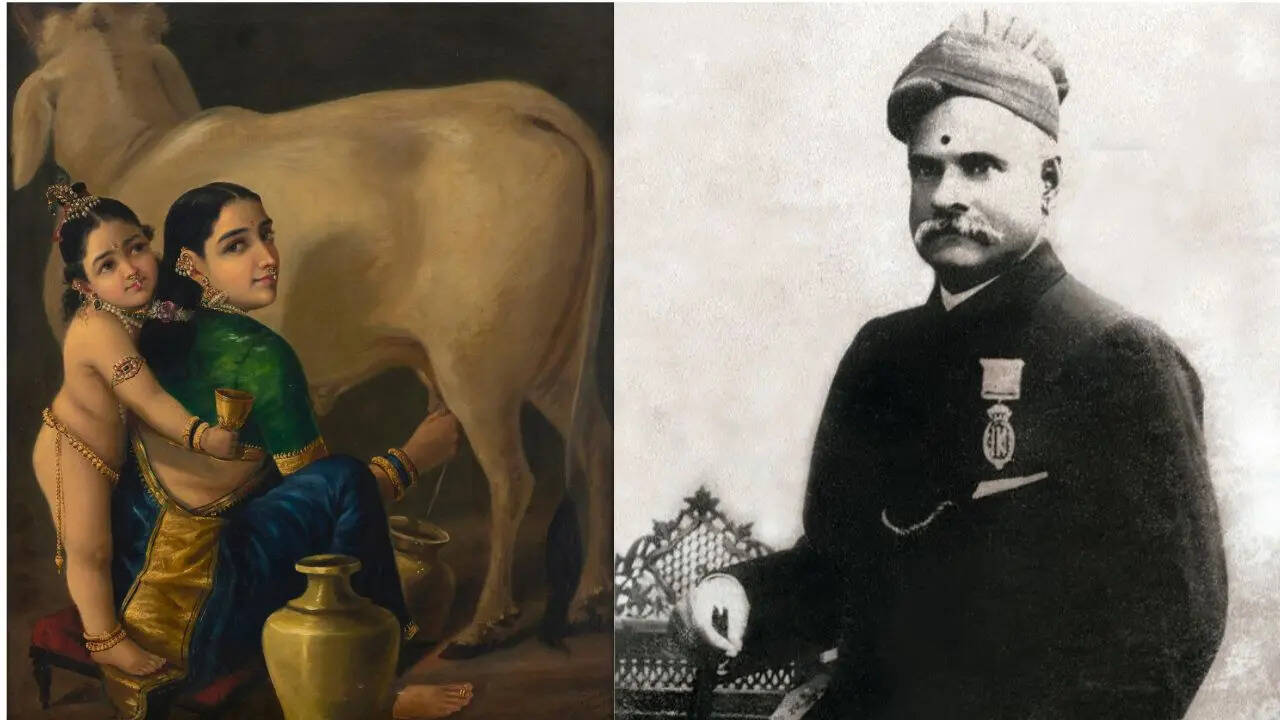
For years, the market has treated Indian art as a layered but loosely priced ecosystem, where modern and contemporary categories led valuation benchmarks while earlier periods were culturally revered but financially under-indexed. This sale collapses that hierarchy. It makes a decisive argument. Primacy is the primary driver of value.
Ravi Varma predates the canon of Modern Indian Art. While he does not belong to the post-Independence generation that dominates auction discourse, he still occupies a position that no modern artist can claim. He authored a visual language that made Indian mythology legible through academic realism, and then democratised it through reproduction.
Markets, when they mature, begin to price origin.
This is precisely what has occurred.
The valuation of Yashoda and Krishna rests on a convergence of factors that rarely align with such clarity. The work belongs to the 1890s, a period widely recognised as the apex of Ravi Varma’s artistic maturity. It is signed, documented, and institutionally circulated. Its provenance is traceable. Its exhibition history is robust. It has lived not only in private collections but in public discourse.
More importantly, it embodies one of the most potent iconographies within the Indian visual canon. The maternal intimacy of Yashoda and Krishna is both historically specific and universally legible. It carries devotional weight while remaining emotionally immediate. This dual register is critical. It allows the work to operate simultaneously as a national object and a global image.
Not all works can do this. The ones that can are priced accordingly.
There is a tendency to view such results as anomalies, as though a record-breaking sale exists outside the logic of the market. That reading is incorrect. This sale is exceptional, but it is not irrational. It sits squarely within the current structure of the global art market, which has become increasingly selective and top-heavy.
Global indices and market reports tell a consistent story. The art market has returned to growth, with global sales reaching approximately $59.6 billion in 2025. Auction activity has strengthened, but the distribution of value remains concentrated. Capital is flowing toward works that combine rarity, provenance, institutional validation, and narrative significance. In other words, toward works that can withstand scrutiny across academia, status, and scarcity.
The Indian market reflects this pattern with increasing clarity. Participation is expanding. A new generation of domestic collector is entering the field. Yet the highest valuations remain tightly clustered around a small group of canonical artists and museum-grade works.
Ravi Varma’s record must therefore be read alongside recent movements in Modern Indian Art. Works by M. F. Husain and others have already pushed that category into international price territory. Those results established the global legitimacy of India’s twentieth-century modernism. Ravi Varma’s result operates on a different axis. It establishes the financial legitimacy of India’s visual origins.
The distinction matters because it signals where the market is headed.
Pre-modern and proto-modern Indian art, particularly works that carry civilisational significance, are likely to undergo a measured but meaningful re-rating over the next decade. This will not be a speculative surge. Supply in this segment is inherently limited. Many works are already held in institutions or long-term collections. What will change is perception.
Collectors will begin to treat such works as collector assets rather than decorative acquisitions. Auction houses will become more selective in what they bring to market, prioritising works with strong documentation and exhibition histories. Scholarship will play an increasingly central role in valuation. The market will, in effect, become more museum-like in its logic.
At the same time, this re-rating will be highly stratified. Not every Ravi Varma will rise. The gap between museum-quality works and secondary material will widen. This is already visible in other segments of the art market globally. The top tier appreciates disproportionately because it is both rare and defensible.
The same dynamic will apply here.
For Modern and Contemporary Indian Art, the outlook is equally clear, though distinct in its trajectory. The modern category has already achieved international validation. Its leading figures are now part of a global conversation, both in terms of pricing and institutional presence. Contemporary Indian art, by contrast, is still in the process of consolidation.
The next phase will depend on three factors. First, institutional support, both within India and internationally. Museums and biennales will play a decisive role in shaping which artists achieve long-term significance. Second, curatorial rigour. The market will increasingly reward artists whose work can sustain critical discourse. Third, global integration. Indian contemporary art will need to position itself within broader narratives of identity, materiality, and political context to command sustained attention.
In financial terms, this suggests a dual-track future. The top end of Modern Indian Art will continue to strengthen, supported by scarcity and established reputations. The contemporary segment will remain more volatile, with sharp divergences between artists who achieve institutional validation and those who remain market-driven.
It is also worth noting that the buyer in this instance, Cyrus Poonawalla, is not an impulsive entrant into the category. Having observed him over time, including through the discipline of horse racing, it is evident that his acquisitions are guided by a calibrated understanding of long-term value. In a conversation some years ago, he remarked that the next generation must learn how to preserve and grow accumulated wealth, and that wealth creation ultimately outweighs short-term profit. This acquisition reads as an extension of that philosophy. It is not a purchase signalling positioning within legacy.
Where, then, does Ravi Varma sit within this landscape?
He sits above it.
His work anchors the same temporal framework. The market’s willingness to pay ₹167.2 crore for Yashoda and Krishna is a statement about the value of origin in a market that is increasingly confident in its own history.
This confidence has consequences.
Other high-quality Ravi Varma works will see upward pressure, particularly those from his mature period with strong mythological subjects and documented provenance. Auction estimates will adjust. Private transactions will recalibrate. Yet this will not be a uniform uplift. It will be selective, reinforcing hierarchies.
This is how serious markets behave.
The market as opposed to inflating indiscriminately will identify, isolate, and elevate.
Ravi Varma’s Yashoda and Krishna has been elevated because it satisfies the most demanding criteria the market can apply. It is historically indispensable, visually definitive, and institutionally validated. It is rare in significance.
That is what ₹167.2 crore buys.
A position in history.
TO BE CONTINUED, FOR SUBSCRIBERS ONLY.
This is where the surface ends and the reporting begins.
The complete piece, the full archive, and access to The French Press Circle. Reporting answerable only to its readers.
Already a subscriber ?
Login
Read these on the house, with our compliments.
A selection from the current issue, open to all readers. Read them in full. The rest is one decision away.







For years, the market has treated Indian art as a layered but loosely priced ecosystem, where modern and contemporary categories led valuation benchmarks while earlier periods were culturally revered but financially under-indexed. This sale collapses that hierarchy. It makes a decisive argument. Primacy is the primary driver of value.
Ravi Varma predates the canon of Modern Indian Art. While he does not belong to the post-Independence generation that dominates auction discourse, he still occupies a position that no modern artist can claim. He authored a visual language that made Indian mythology legible through academic realism, and then democratised it through reproduction.
Markets, when they mature, begin to price origin.
This is precisely what has occurred.
The valuation of Yashoda and Krishna rests on a convergence of factors that rarely align with such clarity. The work belongs to the 1890s, a period widely recognised as the apex of Ravi Varma’s artistic maturity. It is signed, documented, and institutionally circulated. Its provenance is traceable. Its exhibition history is robust. It has lived not only in private collections but in public discourse.
More importantly, it embodies one of the most potent iconographies within the Indian visual canon. The maternal intimacy of Yashoda and Krishna is both historically specific and universally legible. It carries devotional weight while remaining emotionally immediate. This dual register is critical. It allows the work to operate simultaneously as a national object and a global image.
Not all works can do this. The ones that can are priced accordingly.
There is a tendency to view such results as anomalies, as though a record-breaking sale exists outside the logic of the market. That reading is incorrect. This sale is exceptional, but it is not irrational. It sits squarely within the current structure of the global art market, which has become increasingly selective and top-heavy.
Global indices and market reports tell a consistent story. The art market has returned to growth, with global sales reaching approximately $59.6 billion in 2025. Auction activity has strengthened, but the distribution of value remains concentrated. Capital is flowing toward works that combine rarity, provenance, institutional validation, and narrative significance. In other words, toward works that can withstand scrutiny across academia, status, and scarcity.
The Indian market reflects this pattern with increasing clarity. Participation is expanding. A new generation of domestic collector is entering the field. Yet the highest valuations remain tightly clustered around a small group of canonical artists and museum-grade works.
Ravi Varma’s record must therefore be read alongside recent movements in Modern Indian Art. Works by M. F. Husain and others have already pushed that category into international price territory. Those results established the global legitimacy of India’s twentieth-century modernism. Ravi Varma’s result operates on a different axis. It establishes the financial legitimacy of India’s visual origins.
The distinction matters because it signals where the market is headed.
Pre-modern and proto-modern Indian art, particularly works that carry civilisational significance, are likely to undergo a measured but meaningful re-rating over the next decade. This will not be a speculative surge. Supply in this segment is inherently limited. Many works are already held in institutions or long-term collections. What will change is perception.
Collectors will begin to treat such works as collector assets rather than decorative acquisitions. Auction houses will become more selective in what they bring to market, prioritising works with strong documentation and exhibition histories. Scholarship will play an increasingly central role in valuation. The market will, in effect, become more museum-like in its logic.
At the same time, this re-rating will be highly stratified. Not every Ravi Varma will rise. The gap between museum-quality works and secondary material will widen. This is already visible in other segments of the art market globally. The top tier appreciates disproportionately because it is both rare and defensible.
The same dynamic will apply here.
For Modern and Contemporary Indian Art, the outlook is equally clear, though distinct in its trajectory. The modern category has already achieved international validation. Its leading figures are now part of a global conversation, both in terms of pricing and institutional presence. Contemporary Indian art, by contrast, is still in the process of consolidation.
The next phase will depend on three factors. First, institutional support, both within India and internationally. Museums and biennales will play a decisive role in shaping which artists achieve long-term significance. Second, curatorial rigour. The market will increasingly reward artists whose work can sustain critical discourse. Third, global integration. Indian contemporary art will need to position itself within broader narratives of identity, materiality, and political context to command sustained attention.
In financial terms, this suggests a dual-track future. The top end of Modern Indian Art will continue to strengthen, supported by scarcity and established reputations. The contemporary segment will remain more volatile, with sharp divergences between artists who achieve institutional validation and those who remain market-driven.
It is also worth noting that the buyer in this instance, Cyrus Poonawalla, is not an impulsive entrant into the category. Having observed him over time, including through the discipline of horse racing, it is evident that his acquisitions are guided by a calibrated understanding of long-term value. In a conversation some years ago, he remarked that the next generation must learn how to preserve and grow accumulated wealth, and that wealth creation ultimately outweighs short-term profit. This acquisition reads as an extension of that philosophy. It is not a purchase signalling positioning within legacy.
Where, then, does Ravi Varma sit within this landscape?
He sits above it.
His work anchors the same temporal framework. The market’s willingness to pay ₹167.2 crore for Yashoda and Krishna is a statement about the value of origin in a market that is increasingly confident in its own history.
This confidence has consequences.
Other high-quality Ravi Varma works will see upward pressure, particularly those from his mature period with strong mythological subjects and documented provenance. Auction estimates will adjust. Private transactions will recalibrate. Yet this will not be a uniform uplift. It will be selective, reinforcing hierarchies.
This is how serious markets behave.
The market as opposed to inflating indiscriminately will identify, isolate, and elevate.
Ravi Varma’s Yashoda and Krishna has been elevated because it satisfies the most demanding criteria the market can apply. It is historically indispensable, visually definitive, and institutionally validated. It is rare in significance.
That is what ₹167.2 crore buys.
A position in history.
TO BE CONTINUED, FOR SUBSCRIBERS ONLY.
This is where the surface ends and the reporting begins.
The complete piece, the full archive, and access to The French Press Circle. Reporting answerable only to its readers.
Already a subscriber ?
Login
Read these on the house, with our compliments.
A selection from the current issue, open to all readers. Read them in full. The rest is one decision away.