India has over 2.6 million handloom weavers. Between 1995 and 2020, that number dropped from 4.3 million to 2.6 million, largely due to low wages and the relentless competition from power looms. Handloom production itself fell from 7,000 million metres in 2010 to around 4,200 million metres by 2023. Behind each of those numbers is a family, a tradition, and a body of knowledge accumulated over centuries, slowly disappearing. This is the context in which Project Tantavyaa: Shwet Shyam by RSB Foundation arrived at the National Crafts Museum and Hastkala Academy in New Delhi, and it is the context that makes the initiative worth paying serious attention to.
वेत श्याम by Tanतavyaa
The showcase opened on 27th April and runs through 2nd May 2026. Over two evenings, it brought together over 100 handcrafted textile pieces, live classical vocals, devotional philosophy, culinary heritage, and one of the more compelling personal origin stories behind any cultural event in recent memory.
The Colour of Devotion
वेत श्याम by Tanतavyaa
The name of the exhibit, Shwet Shyam, literally translates to white and black, the chromatic duality most directly associated with Lord Krishna. When asked how that is reciprocated into the language of craft, Priyanka Behera, Director of CSR at RSB Group and the architect of Tantavyaa, was precise: "We have the entire collection in muslin, but we have kept every colour very muted, in the form of whites and blacks only, and hints of blue here and there, because that's the colour palette of Krishna. This is a textural tale of devotion, very much like Krishna, how he has transcended all boundaries. He is omnipresent, and similarly so are our crafts, and they have no limitations or restrictions, no boundaries of culture or caste or anything - just like Krishna. The beauty of craft is timeless, and that describes our Indian culture."
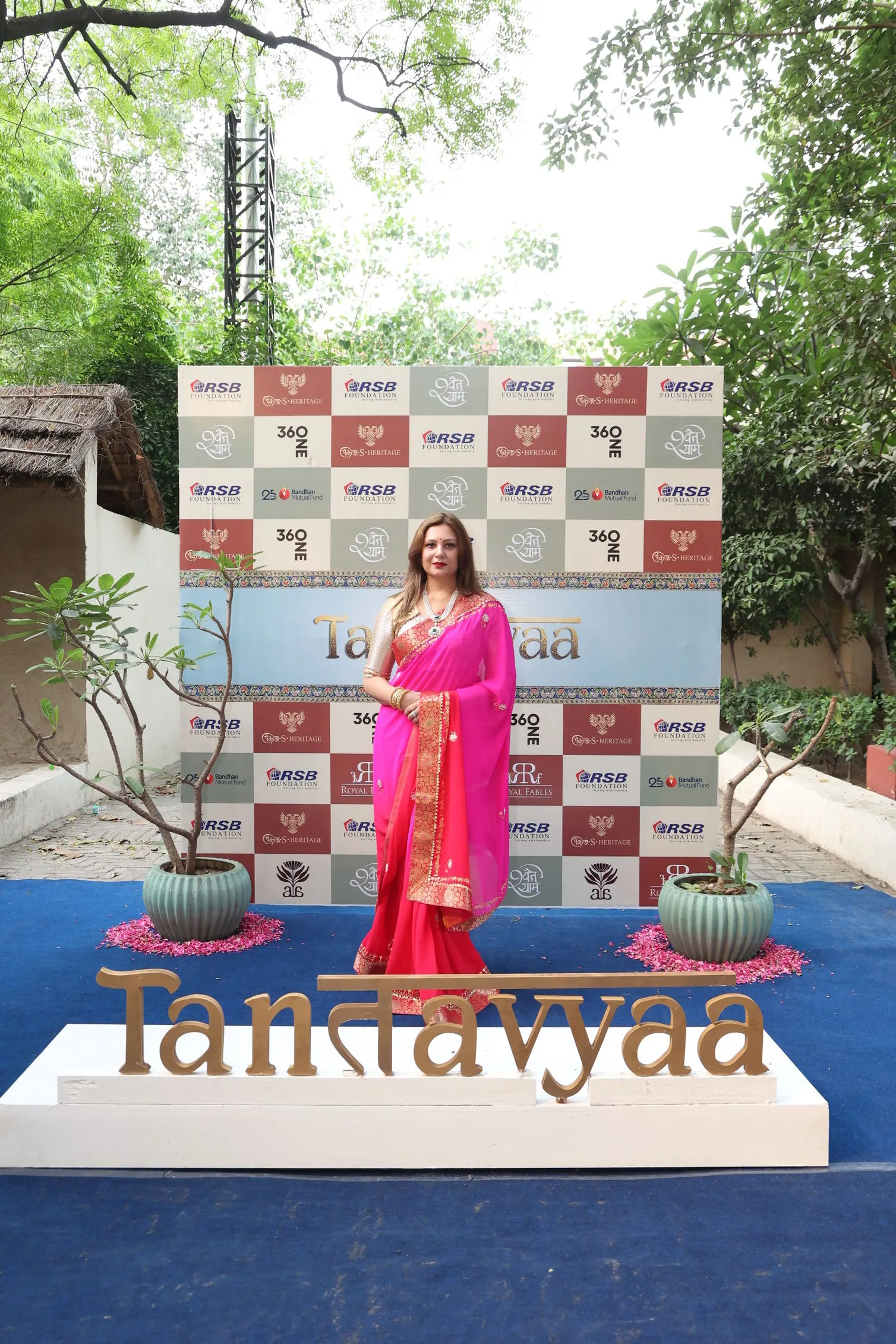
Ms. Priyanka Behera, Director CSR, RSB Group
The way Priyanka Behera has framed this captures the whole essence of the exhibit fittingly. It is the conceptual spine of the entire exhibit. The ivory angarkhas, the deep indigo accents, the muted earth tones running through every piece were chosen to carry theological weight. The palette was an argument in itself, not only an aesthetic preference.
The Devotional Geography of Eastern India
The three regions at the heart of Tantavyaa, Odisha, Bengal, and Assam, share a devotional cartography that runs deeper than geography.
In Assam, Vaishnavism became a major religious force when reformer Sankardev led a neo-Vaishnavism movement in the 16th century. On a pilgrimage to the Jagannath Temple in Puri, Odisha, Sankardev experienced a spiritual illumination, then returned to Assam to preach the devotional love of Krishna, beginning what became known as the Bhakti Movement in the northeast. The faith he established reduced the emphasis on Vedic ritualism and centred instead on devotion to Krishna through congregational listening and the singing of his name and deeds. Out of this movement grew Sattriya, a dance and artistic tradition crafted by Sankardev in which every performance was a ritual offering, and whose compositions were dedicated to depicting episodes from Krishna's life.
In Bengal, the bhakti tradition ran through Chaitanya Mahaprabhu, whose movement, like Sankardev's, remained popular among common people, not only scholarly Brahmins, and spread the worship of Krishna through vernacular song and devotion. And at Jagannath Puri, the temple has functioned as one of the four Char Dham pilgrimage sites for Hindus, and was the place where the famous devotional poem Gita Govinda was first introduced into liturgy.
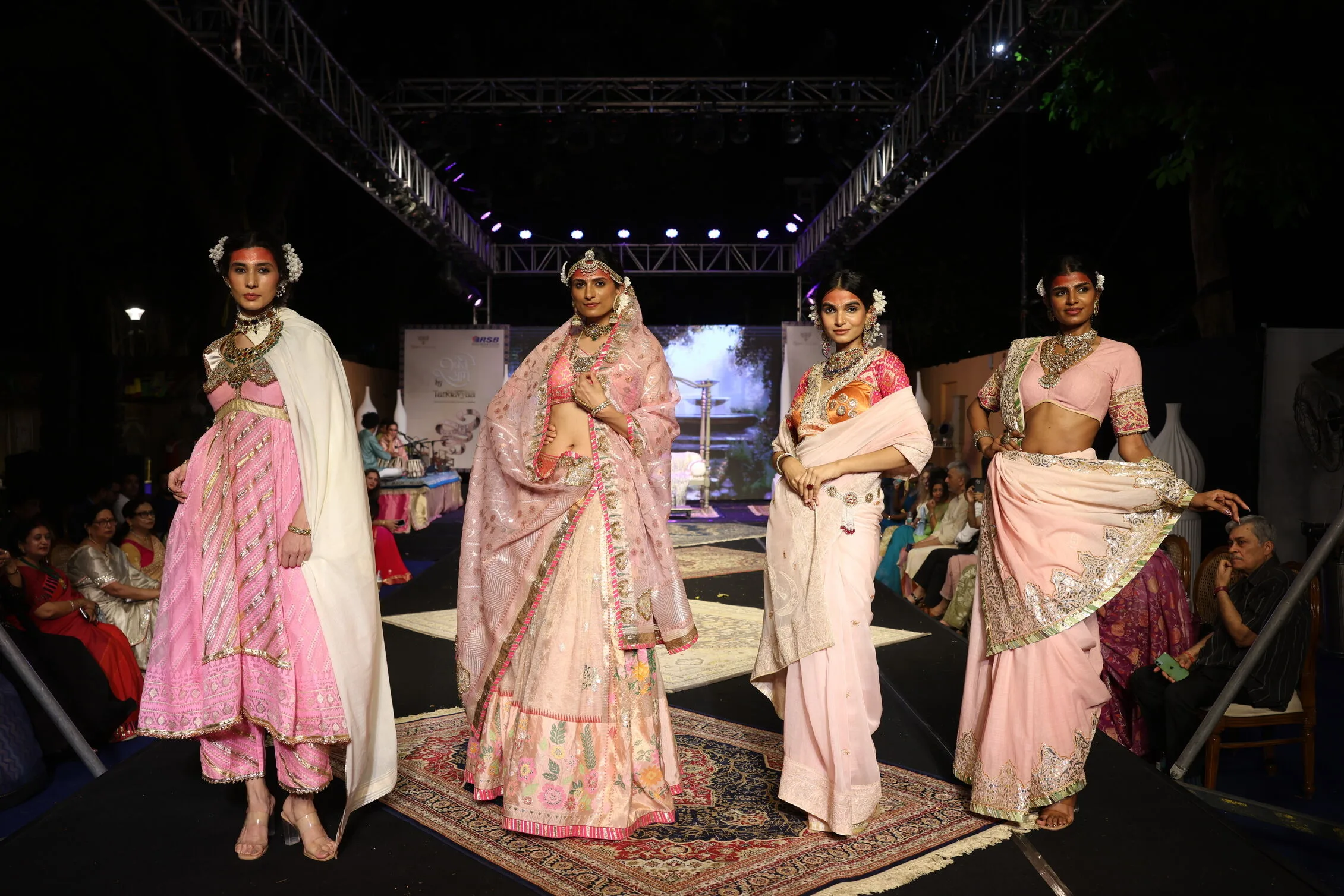
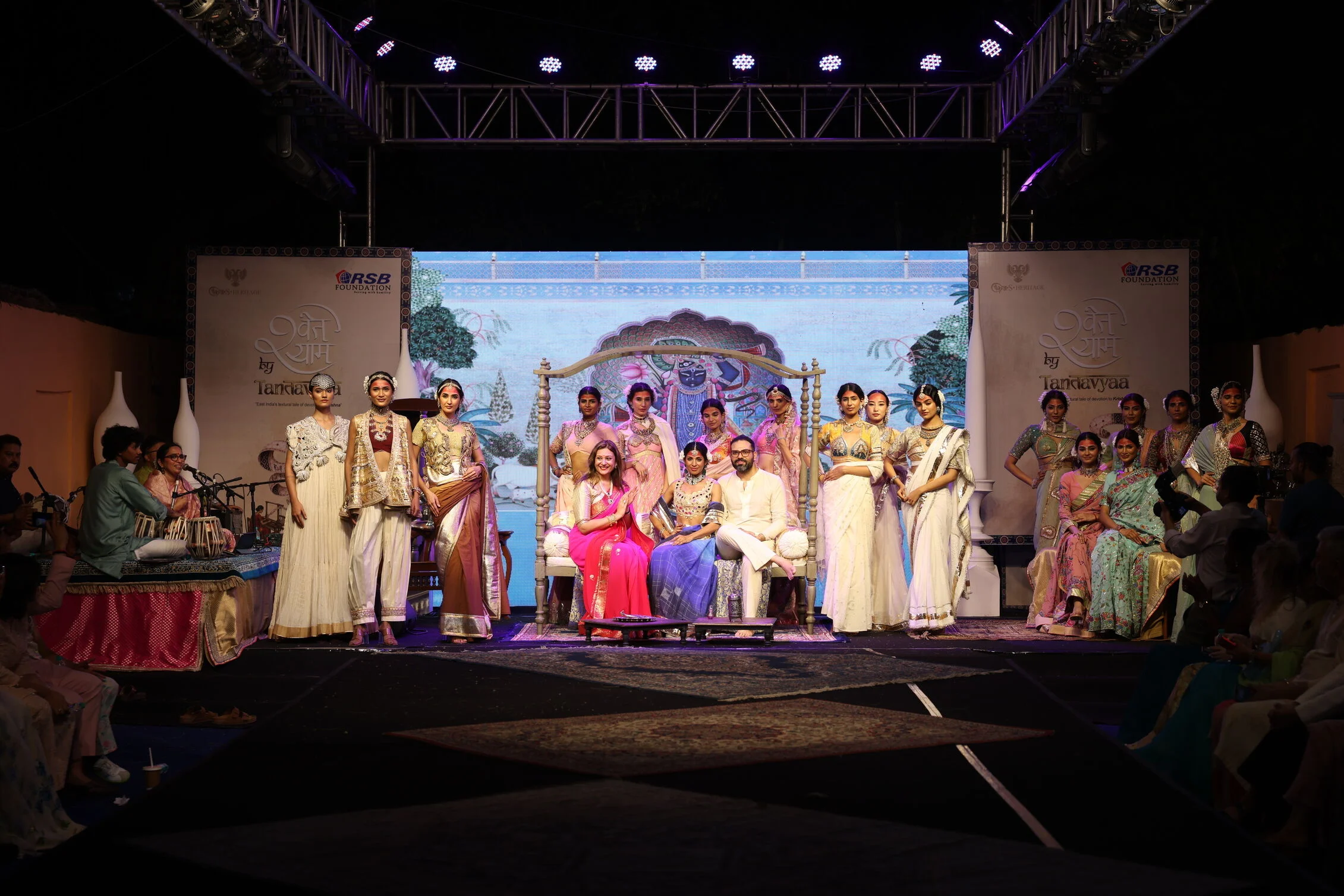
Models Adorned In Textiles Revived by Pankaj S. Heritage
What all three regions share, then, is a tradition in which craft, music, and faith were never separate disciplines. The weaver, the dancer, and the devotee were drawing from the same well. Tantavyaa as an exhibit strives to showcase this philosophy in a tangible form, and its textile selections reflect it.
The Weight of a Weave
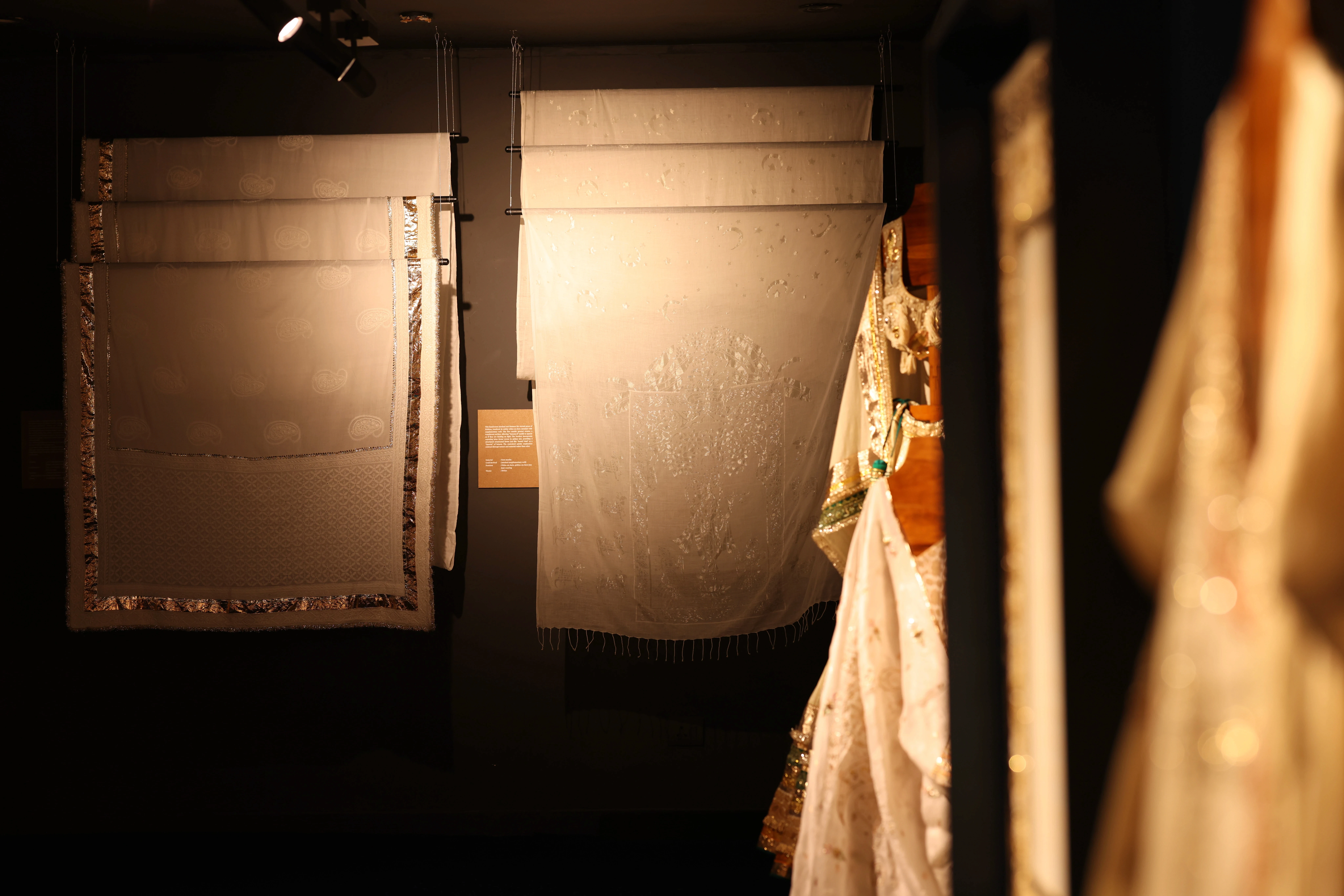
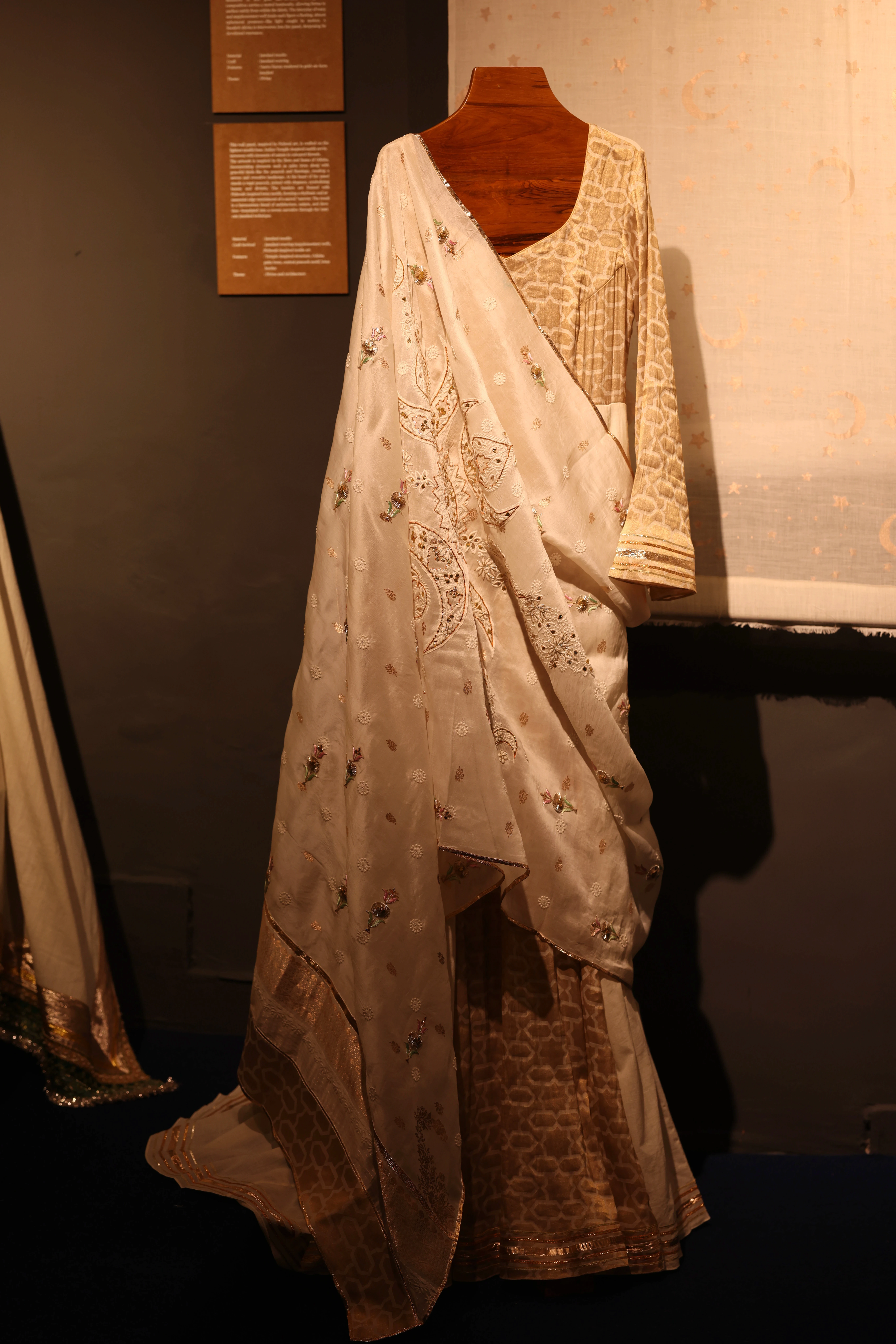
The Jamdani drapes in the showcase carry one of the more extraordinary histories in world textile culture. The traditional art of Jamdani weaving was declared a UNESCO Intangible Cultural Heritage of Humanity in 2013. Woven on a handloom using the discontinuous weft technique, Jamdani is time-consuming and labour-intensive precisely because of the richness of its motifs, which are created directly on the loom. During British rule, Bengal's Jamdani and muslin industries rapidly declined due to competition from industrially manufactured British textiles. That history of suppression makes its presence in a showcase about revival particularly pointed.
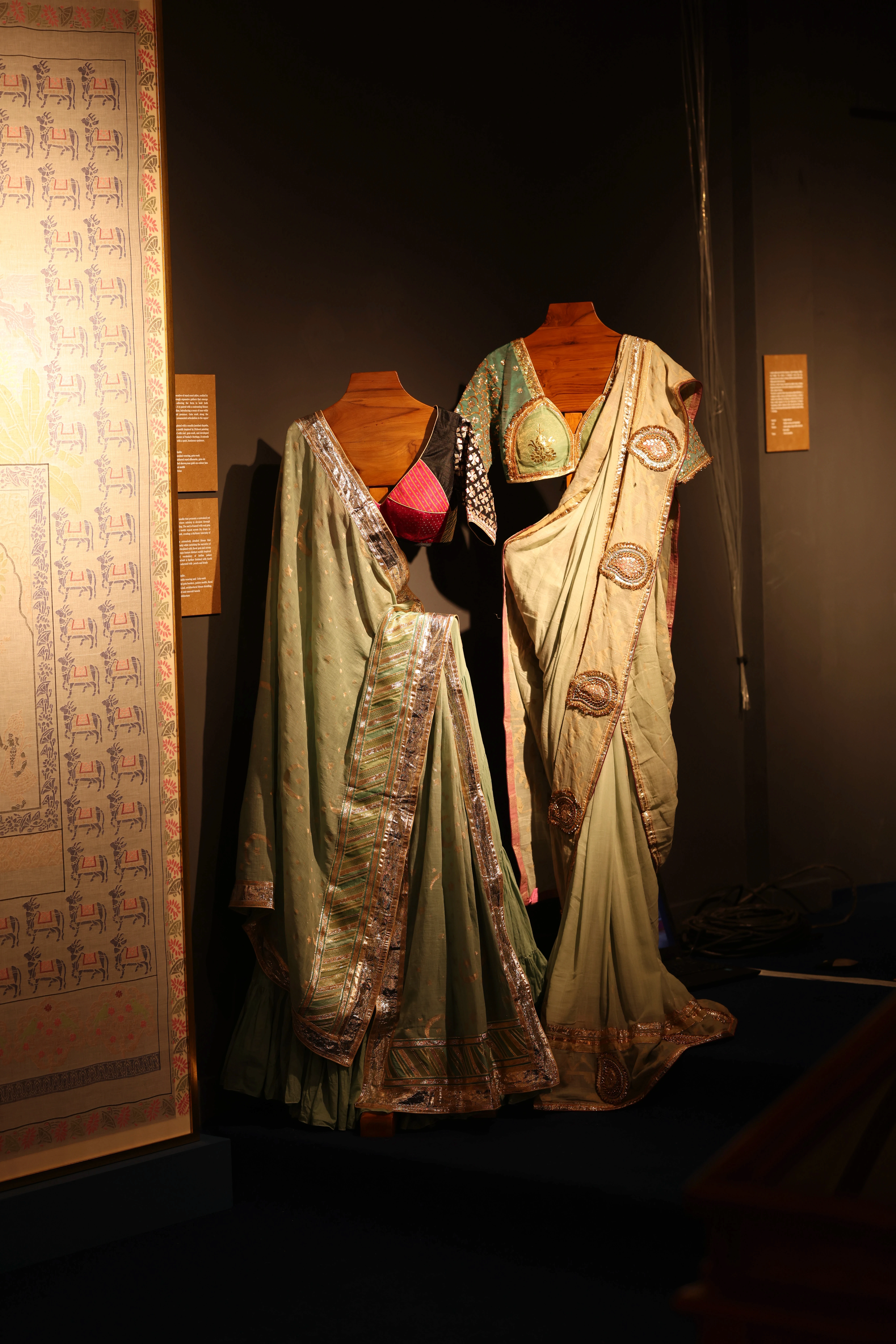
वेत श्याम by Tanतavyaa
The Muga silk from Assam carries an equal significance. Muga silk is a variety of wild silk geographically tagged to Assam, known for its extreme durability and natural yellowish-golden tint with a shimmering, glossy texture. It was previously reserved for the use of royalty. Its history is associated with the Ahom dynasty, which ruled from 1228 to 1828 CE, and the production and cultivation of Muga silk were encouraged by royals and aristocrats, contributing to the rise of skilled silk rearers and weavers. In 2007, Muga silk was granted Geographical Indication status, signifying its origins in Assam and protecting its authenticity. In Assam, it is a matter of pride for a woman to own a Muga mekhela chador. It is generally passed on as an heirloom piece or gifted to a bride in her wedding trousseau, considered as significant as gold ornaments.
Why the East, and Why Now
The geographic focus of Tantavyaa was personal before it was political. RSB Director Priyanka Behera was direct about the reasoning. Most CSR funding in India concentrates in the western and southern regions, not out of indifference, but because that is where the majority of corporate head offices and plants are located. The eastern region receives considerably less attention. As someone born and raised in Odisha, Behera wanted to correct that imbalance through this project.
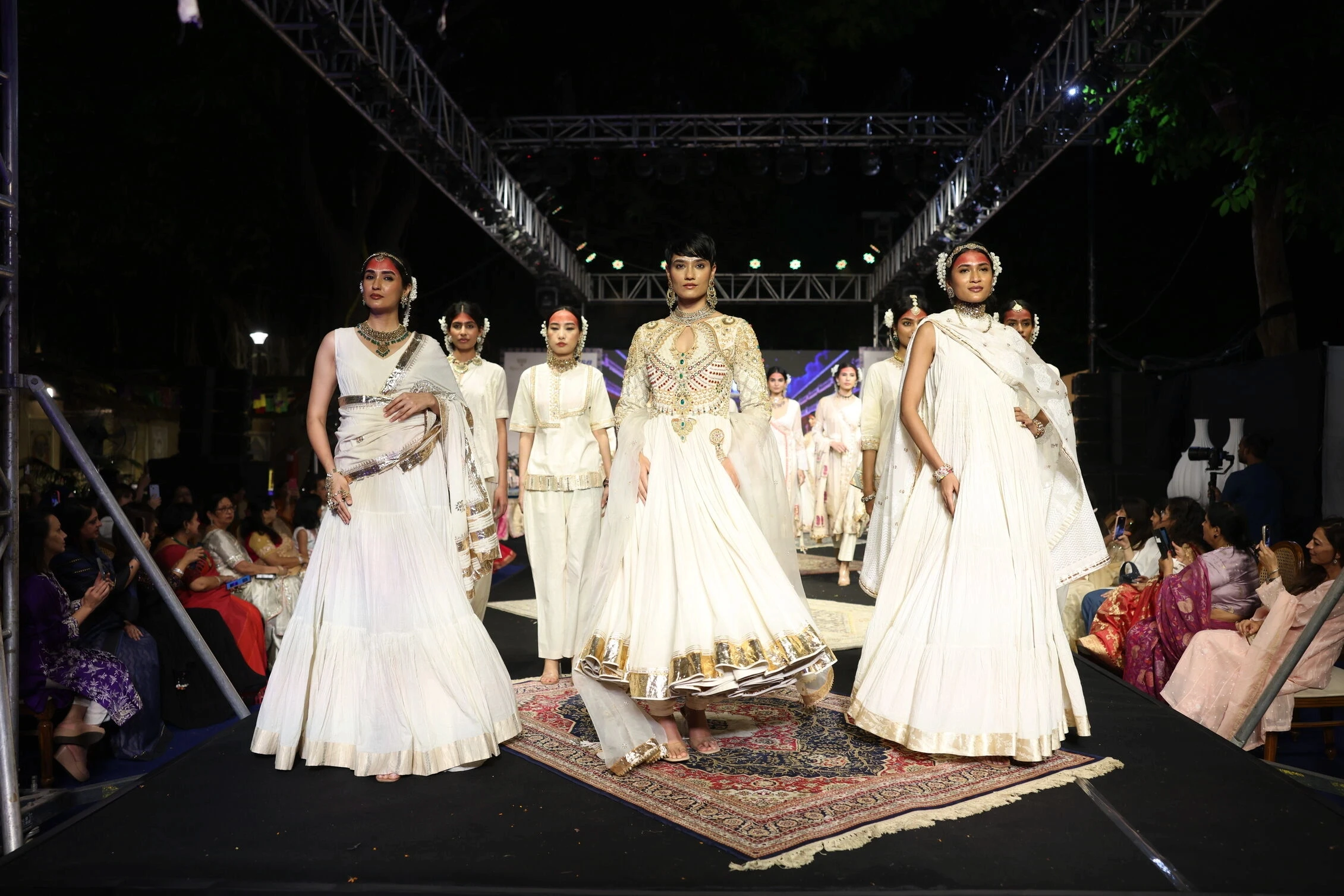
Models Adorned In Textiles Revived by Pankaj S. Heritage
"RSB Foundation already does a lot of work for tribal and primitive communities in that region, in terms of healthcare, cancer care, and education. We have schools, hospitals, and we are about to open a cancer centre. Craft became one more medium to create livelihood opportunities, and keeping women at the centre of it was important to me. I wanted it to be a woman-led project, majorly catering to women, for their Swabhiman."
That instinct is backed by a stark reality. According to the Handloom Census of 2019 to 2020, approximately 72.29 percent of all handloom workers in India are women. The sector's decline is therefore not a neutral economic event. It is one that falls disproportionately on women in rural communities. Tantavyaa's insistence on women-led craft production as a livelihood model is, in that light, both a cultural choice and a structural intervention.
Recreating the Baithak
If the first evening made the argument, the second evening dressed it. Revivalist designer Pankaj S. curated a fashion theatre titled Recreating the Baithak Era, and the choice of reference was deliberate and historically grounded. The tradition of the classical baithak dates back to the Mughal era and the time of ancient royal patronage, where court musicians would perform in closed settings for kings, queens, and elite listeners. Unlike modern concert halls with amplification and stage lighting, baithaks were typically acoustic and deeply immersive. In Hindustani Classical Music tradition, a baithak is a musical performance in a homely and intimate environment where musicians perform in close proximity to the audience, as opposed to a more formal concert on a stage.
Revivalist Pankaj of brand Pankaj. S. Heritage and Priyanka Behera, Director CSR, RSB Group with the models
What the baithak represented, at its best, was a collapse of hierarchy between the art object and the audience. Music was not performed at you; it happened around you. Craft was not displayed behind glass; it was worn, discussed, touched. The fashion theatre Chadha built tried to reconstruct that intimacy, with handwoven Muslin, Muga silk, and Jamdani drapes moving through the space accompanied by live classical vocals from Vidya Shah. Angarkhas, layered veils, and handwoven saris in ivory, deep indigo, and muted earth tones. Each piece was months of accumulated skill made visible.
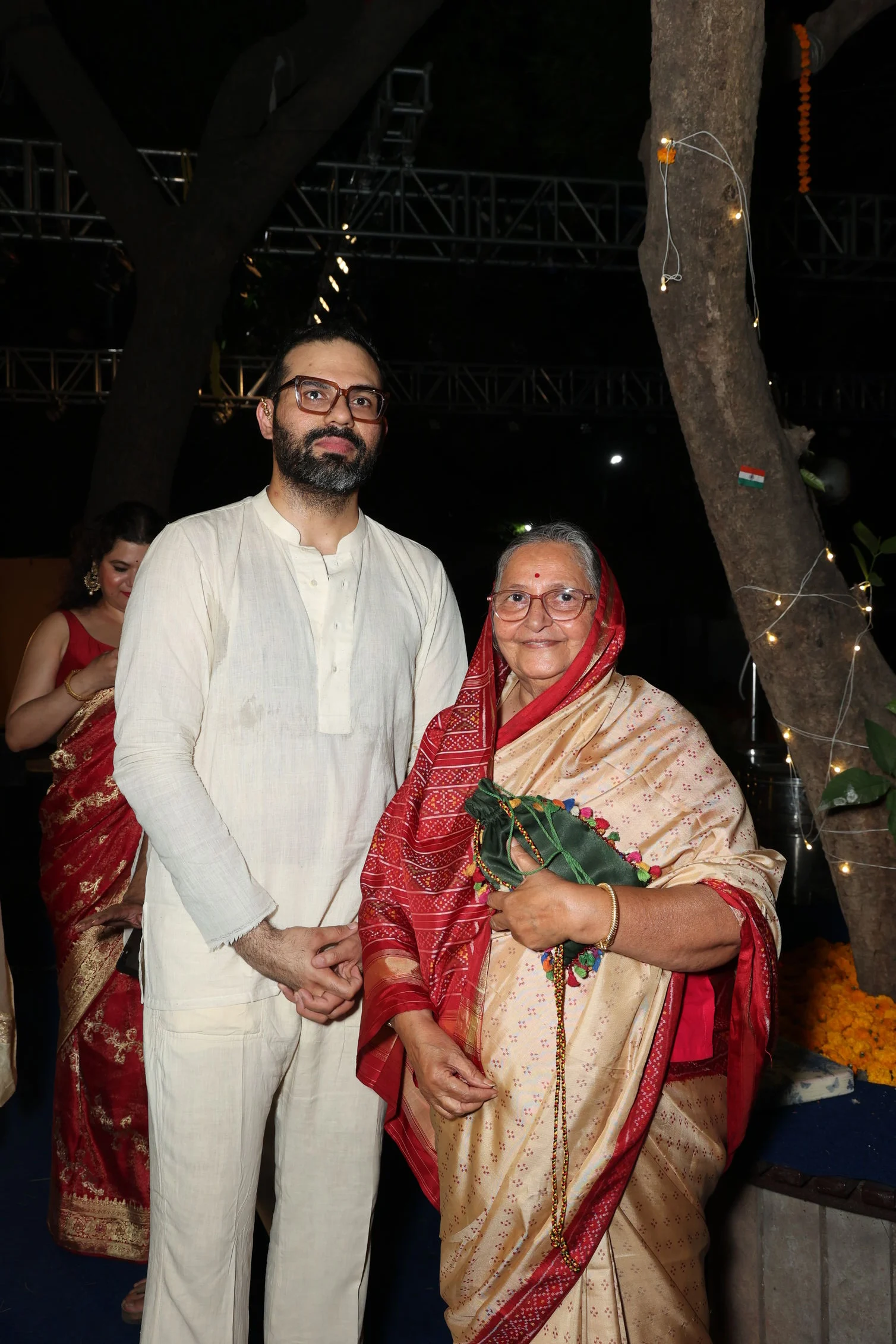
Revivalist Pankaj of brand Pankaj . S . Heritage with Maharaj Kumari Kalpana Kumari of Wankaner
"These textiles carry stories of people, places, and traditions that have been passed down over generations," Pankaj notes. "Through Tantavyaa, we are trying to bring them back into everyday conversation and give them the space they deserve today."
The Opening Night
The opening evening at the National Crafts Museum began with a traditional Mangalacharan performance and was inaugurated by Union Minister Shri Dharmendra Pradhan, who connected the initiative to the national discourse around Swadeshi 2.0. His Holiness Indradyumna Swami Ji launched a book and introduced a spiritual dimension that gave the event its fullest register: cultural, economic, and devotional simultaneously. Eminent royals from Baroda, Udaipur, and Dhenkanal attended, from HH Maharani Radhika Raje Gaekwad to Shriji Huzur Dr. Lakshyaraj Singh Ji, reinforcing a sense of generational continuity, of India's custodians of heritage choosing to show up for its revival.
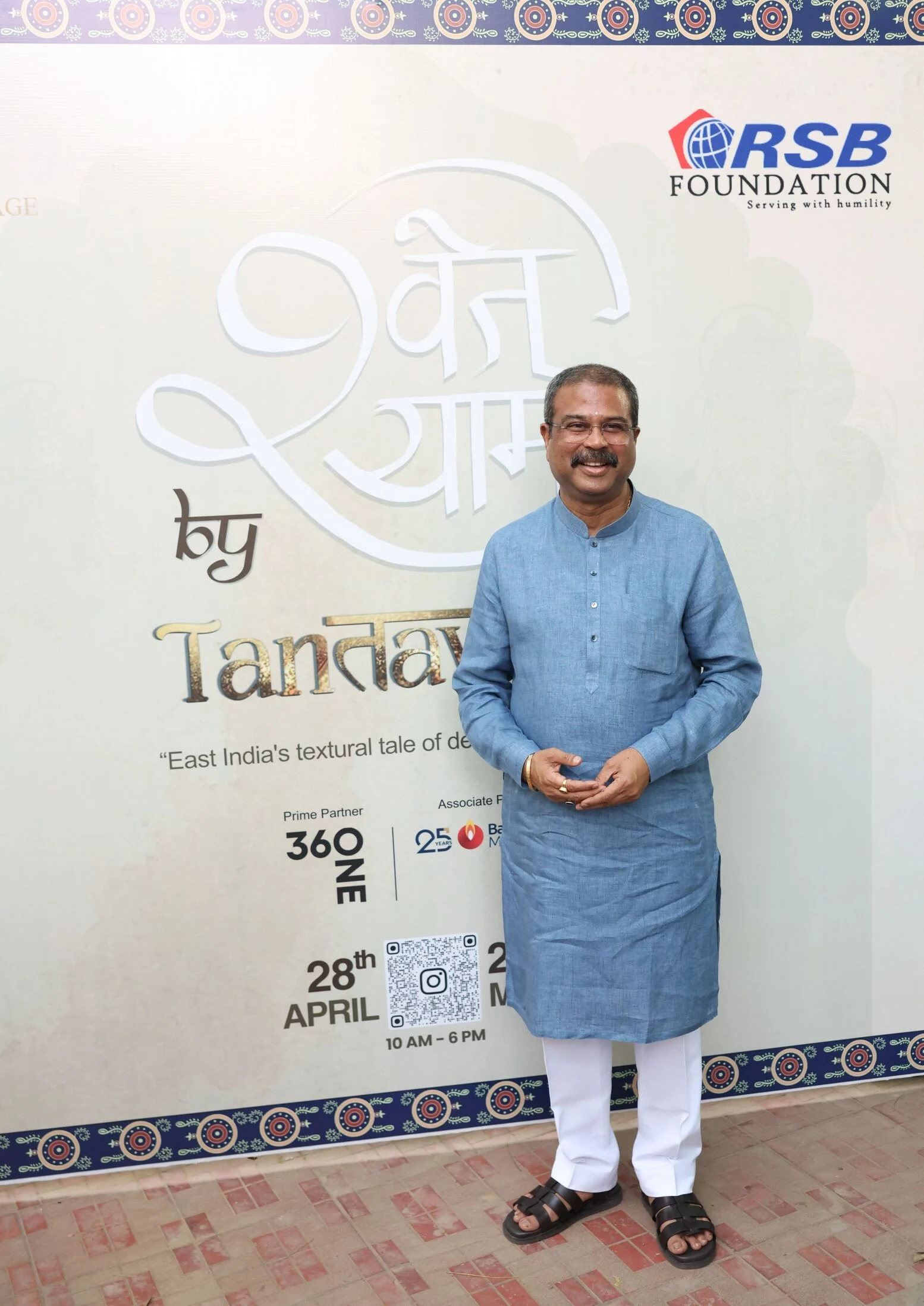
Union Minister of Education, Skill Development, Entrepreneurship Shri Dharmendra Pradhan Ji
The evening also closed with a presentation of Dhenkanal's culinary heritage from Odisha, a district with its own deep food culture, from its use of local ingredients such as rice, pulses, and a significant variety of greens and vegetables, spiced with cumin, mustard, fenugreek, and panch phoran, to the GI-tagged Magji Laddu made from buffalo milk. It was a reminder that culture accumulates in kitchens as much as on looms, and that Tantavyaa understood both.
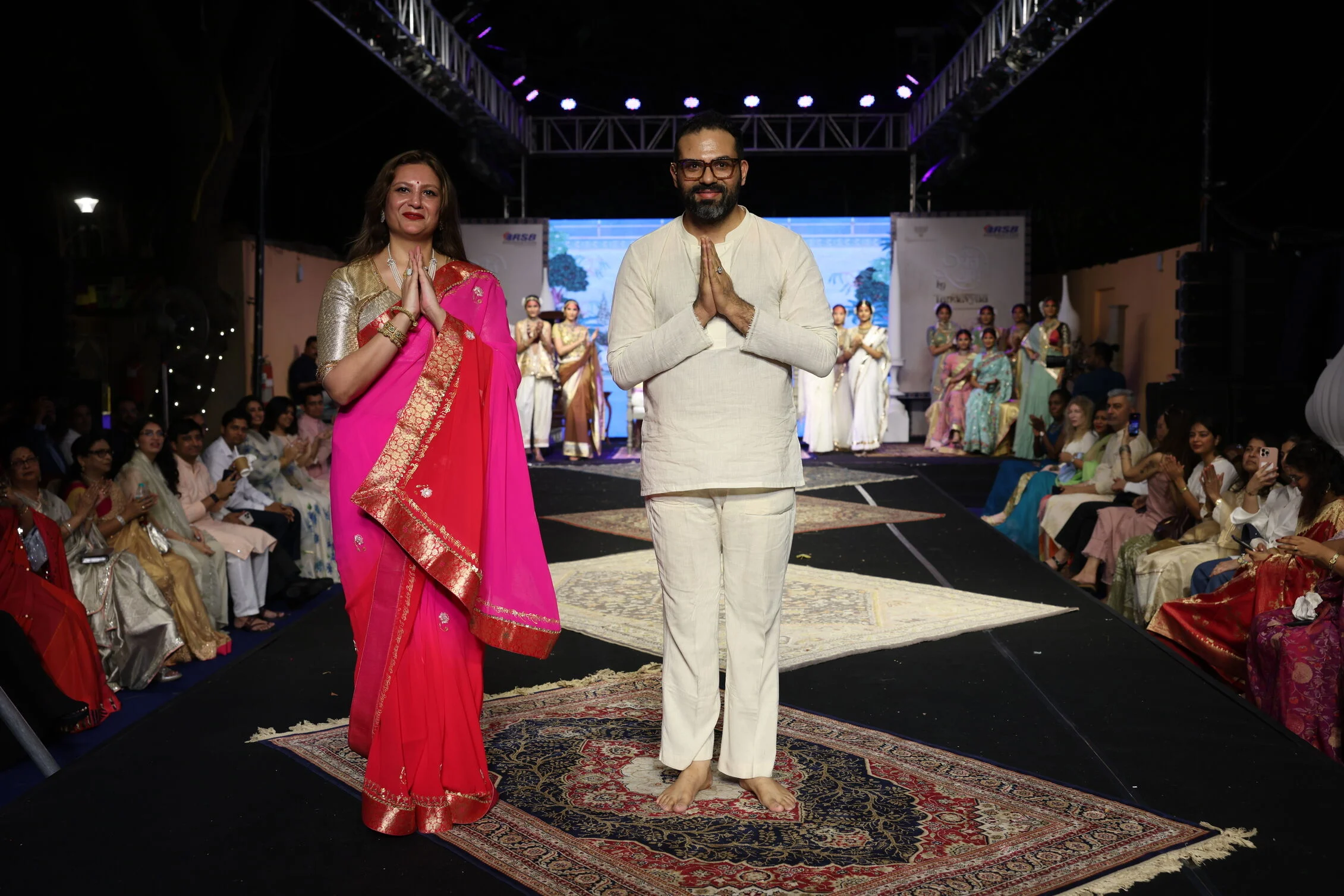
Revivalist Pankaj of brand Pankaj. S. Heritage and Priyanka Behera, Director CSR, RSB Group
Reflecting on both evenings, Behera articulated the ambition with clarity: "The Baithak tradition shaped generations of artists, patrons, and thinkers. By recreating that era and pairing it with a fashion showcase that draws from the same aesthetic roots, we hope to inspire a new generation to look inward, to find elegance, identity, and pride in what is uniquely and beautifully ours."
A Must Visit For Craft Aficionados
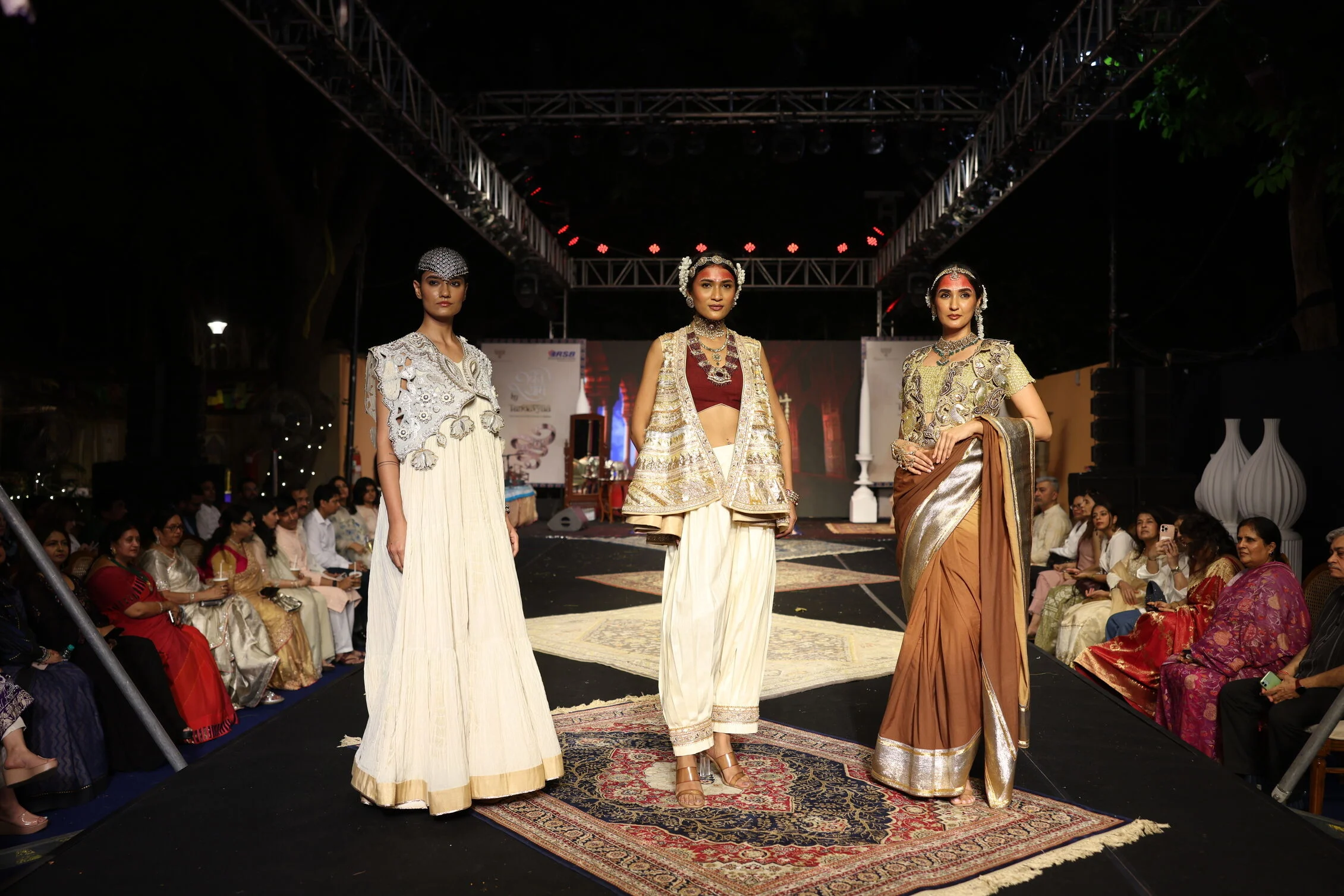
Models Adorned In Textiles Revived by Pankaj S. Heritage
Shwet Shyam presented by Project Tantavyaa is open to the public from 27th April through 2nd May 2026 at the National Crafts Museum and Hastkala Academy, New Delhi. If the preceding weeks have left you feeling saturated by the noise of contemporary culture, this is the antidote. A showcase that understands the difference between nostalgia and revival, and chooses the latter. Where each textile carries a legal history, a spiritual tradition, and the labour of hands that have been doing this work for generations. You owe it to yourself to see it before it closes.
Project Tantavyaa: Shwet Shyam by RSB Foundation | National Crafts Museum and Hastkala Academy, New Delhi | Open to public: 27th April to 2nd May 2026
TO BE CONTINUED, FOR SUBSCRIBERS ONLY.
This is where the surface ends and the reporting begins.
The complete piece, the full archive, and access to The French Press Circle. Reporting answerable only to its readers.
Already a subscriber ?
Login
Read these on the house, with our compliments.
A selection from the current issue, open to all readers. Read them in full. The rest is one decision away.




India has over 2.6 million handloom weavers. Between 1995 and 2020, that number dropped from 4.3 million to 2.6 million, largely due to low wages and the relentless competition from power looms. Handloom production itself fell from 7,000 million metres in 2010 to around 4,200 million metres by 2023. Behind each of those numbers is a family, a tradition, and a body of knowledge accumulated over centuries, slowly disappearing. This is the context in which Project Tantavyaa: Shwet Shyam by RSB Foundation arrived at the National Crafts Museum and Hastkala Academy in New Delhi, and it is the context that makes the initiative worth paying serious attention to.
वेत श्याम by Tanतavyaa
The showcase opened on 27th April and runs through 2nd May 2026. Over two evenings, it brought together over 100 handcrafted textile pieces, live classical vocals, devotional philosophy, culinary heritage, and one of the more compelling personal origin stories behind any cultural event in recent memory.
The Colour of Devotion
वेत श्याम by Tanतavyaa
The name of the exhibit, Shwet Shyam, literally translates to white and black, the chromatic duality most directly associated with Lord Krishna. When asked how that is reciprocated into the language of craft, Priyanka Behera, Director of CSR at RSB Group and the architect of Tantavyaa, was precise: "We have the entire collection in muslin, but we have kept every colour very muted, in the form of whites and blacks only, and hints of blue here and there, because that's the colour palette of Krishna. This is a textural tale of devotion, very much like Krishna, how he has transcended all boundaries. He is omnipresent, and similarly so are our crafts, and they have no limitations or restrictions, no boundaries of culture or caste or anything - just like Krishna. The beauty of craft is timeless, and that describes our Indian culture."
Ms. Priyanka Behera, Director CSR, RSB Group
The way Priyanka Behera has framed this captures the whole essence of the exhibit fittingly. It is the conceptual spine of the entire exhibit. The ivory angarkhas, the deep indigo accents, the muted earth tones running through every piece were chosen to carry theological weight. The palette was an argument in itself, not only an aesthetic preference.
The Devotional Geography of Eastern India
The three regions at the heart of Tantavyaa, Odisha, Bengal, and Assam, share a devotional cartography that runs deeper than geography.
In Assam, Vaishnavism became a major religious force when reformer Sankardev led a neo-Vaishnavism movement in the 16th century. On a pilgrimage to the Jagannath Temple in Puri, Odisha, Sankardev experienced a spiritual illumination, then returned to Assam to preach the devotional love of Krishna, beginning what became known as the Bhakti Movement in the northeast. The faith he established reduced the emphasis on Vedic ritualism and centred instead on devotion to Krishna through congregational listening and the singing of his name and deeds. Out of this movement grew Sattriya, a dance and artistic tradition crafted by Sankardev in which every performance was a ritual offering, and whose compositions were dedicated to depicting episodes from Krishna's life.
In Bengal, the bhakti tradition ran through Chaitanya Mahaprabhu, whose movement, like Sankardev's, remained popular among common people, not only scholarly Brahmins, and spread the worship of Krishna through vernacular song and devotion. And at Jagannath Puri, the temple has functioned as one of the four Char Dham pilgrimage sites for Hindus, and was the place where the famous devotional poem Gita Govinda was first introduced into liturgy.
Models Adorned In Textiles Revived by Pankaj S. Heritage
What all three regions share, then, is a tradition in which craft, music, and faith were never separate disciplines. The weaver, the dancer, and the devotee were drawing from the same well. Tantavyaa as an exhibit strives to showcase this philosophy in a tangible form, and its textile selections reflect it.
The Weight of a Weave
The Jamdani drapes in the showcase carry one of the more extraordinary histories in world textile culture. The traditional art of Jamdani weaving was declared a UNESCO Intangible Cultural Heritage of Humanity in 2013. Woven on a handloom using the discontinuous weft technique, Jamdani is time-consuming and labour-intensive precisely because of the richness of its motifs, which are created directly on the loom. During British rule, Bengal's Jamdani and muslin industries rapidly declined due to competition from industrially manufactured British textiles. That history of suppression makes its presence in a showcase about revival particularly pointed.
वेत श्याम by Tanतavyaa
The Muga silk from Assam carries an equal significance. Muga silk is a variety of wild silk geographically tagged to Assam, known for its extreme durability and natural yellowish-golden tint with a shimmering, glossy texture. It was previously reserved for the use of royalty. Its history is associated with the Ahom dynasty, which ruled from 1228 to 1828 CE, and the production and cultivation of Muga silk were encouraged by royals and aristocrats, contributing to the rise of skilled silk rearers and weavers. In 2007, Muga silk was granted Geographical Indication status, signifying its origins in Assam and protecting its authenticity. In Assam, it is a matter of pride for a woman to own a Muga mekhela chador. It is generally passed on as an heirloom piece or gifted to a bride in her wedding trousseau, considered as significant as gold ornaments.
Why the East, and Why Now
The geographic focus of Tantavyaa was personal before it was political. RSB Director Priyanka Behera was direct about the reasoning. Most CSR funding in India concentrates in the western and southern regions, not out of indifference, but because that is where the majority of corporate head offices and plants are located. The eastern region receives considerably less attention. As someone born and raised in Odisha, Behera wanted to correct that imbalance through this project.
Models Adorned In Textiles Revived by Pankaj S. Heritage
"RSB Foundation already does a lot of work for tribal and primitive communities in that region, in terms of healthcare, cancer care, and education. We have schools, hospitals, and we are about to open a cancer centre. Craft became one more medium to create livelihood opportunities, and keeping women at the centre of it was important to me. I wanted it to be a woman-led project, majorly catering to women, for their Swabhiman."
That instinct is backed by a stark reality. According to the Handloom Census of 2019 to 2020, approximately 72.29 percent of all handloom workers in India are women. The sector's decline is therefore not a neutral economic event. It is one that falls disproportionately on women in rural communities. Tantavyaa's insistence on women-led craft production as a livelihood model is, in that light, both a cultural choice and a structural intervention.
Recreating the Baithak
If the first evening made the argument, the second evening dressed it. Revivalist designer Pankaj S. curated a fashion theatre titled Recreating the Baithak Era, and the choice of reference was deliberate and historically grounded. The tradition of the classical baithak dates back to the Mughal era and the time of ancient royal patronage, where court musicians would perform in closed settings for kings, queens, and elite listeners. Unlike modern concert halls with amplification and stage lighting, baithaks were typically acoustic and deeply immersive. In Hindustani Classical Music tradition, a baithak is a musical performance in a homely and intimate environment where musicians perform in close proximity to the audience, as opposed to a more formal concert on a stage.
Revivalist Pankaj of brand Pankaj. S. Heritage and Priyanka Behera, Director CSR, RSB Group with the models
What the baithak represented, at its best, was a collapse of hierarchy between the art object and the audience. Music was not performed at you; it happened around you. Craft was not displayed behind glass; it was worn, discussed, touched. The fashion theatre Chadha built tried to reconstruct that intimacy, with handwoven Muslin, Muga silk, and Jamdani drapes moving through the space accompanied by live classical vocals from Vidya Shah. Angarkhas, layered veils, and handwoven saris in ivory, deep indigo, and muted earth tones. Each piece was months of accumulated skill made visible.
Revivalist Pankaj of brand Pankaj . S . Heritage with Maharaj Kumari Kalpana Kumari of Wankaner
"These textiles carry stories of people, places, and traditions that have been passed down over generations," Pankaj notes. "Through Tantavyaa, we are trying to bring them back into everyday conversation and give them the space they deserve today."
The Opening Night
The opening evening at the National Crafts Museum began with a traditional Mangalacharan performance and was inaugurated by Union Minister Shri Dharmendra Pradhan, who connected the initiative to the national discourse around Swadeshi 2.0. His Holiness Indradyumna Swami Ji launched a book and introduced a spiritual dimension that gave the event its fullest register: cultural, economic, and devotional simultaneously. Eminent royals from Baroda, Udaipur, and Dhenkanal attended, from HH Maharani Radhika Raje Gaekwad to Shriji Huzur Dr. Lakshyaraj Singh Ji, reinforcing a sense of generational continuity, of India's custodians of heritage choosing to show up for its revival.
Union Minister of Education, Skill Development, Entrepreneurship Shri Dharmendra Pradhan Ji
The evening also closed with a presentation of Dhenkanal's culinary heritage from Odisha, a district with its own deep food culture, from its use of local ingredients such as rice, pulses, and a significant variety of greens and vegetables, spiced with cumin, mustard, fenugreek, and panch phoran, to the GI-tagged Magji Laddu made from buffalo milk. It was a reminder that culture accumulates in kitchens as much as on looms, and that Tantavyaa understood both.
Revivalist Pankaj of brand Pankaj. S. Heritage and Priyanka Behera, Director CSR, RSB Group
Reflecting on both evenings, Behera articulated the ambition with clarity: "The Baithak tradition shaped generations of artists, patrons, and thinkers. By recreating that era and pairing it with a fashion showcase that draws from the same aesthetic roots, we hope to inspire a new generation to look inward, to find elegance, identity, and pride in what is uniquely and beautifully ours."
A Must Visit For Craft Aficionados
Models Adorned In Textiles Revived by Pankaj S. Heritage
Shwet Shyam presented by Project Tantavyaa is open to the public from 27th April through 2nd May 2026 at the National Crafts Museum and Hastkala Academy, New Delhi. If the preceding weeks have left you feeling saturated by the noise of contemporary culture, this is the antidote. A showcase that understands the difference between nostalgia and revival, and chooses the latter. Where each textile carries a legal history, a spiritual tradition, and the labour of hands that have been doing this work for generations. You owe it to yourself to see it before it closes.
Project Tantavyaa: Shwet Shyam by RSB Foundation | National Crafts Museum and Hastkala Academy, New Delhi | Open to public: 27th April to 2nd May 2026
TO BE CONTINUED, FOR SUBSCRIBERS ONLY.
This is where the surface ends and the reporting begins.
The complete piece, the full archive, and access to The French Press Circle. Reporting answerable only to its readers.
Already a subscriber ?
Login
Read these on the house, with our compliments.
A selection from the current issue, open to all readers. Read them in full. The rest is one decision away.